Get Full Government Meeting Transcripts, Videos, & Alerts Forever!
Get email alerts on the Stormwater Master Plan topic
No spam. Unsubscribe anytime.
Metro Water outlines multi-year stormwater inventory and master plan; completion expected in 2028
Summary
Metro Water Services told the committee it has completed about one-third of a new countywide stormwater inventory, will update GIS assets and identify projects for the capital plan, and expects to finish the master plan in 2028. The work will drive project prioritization and funding decisions paid from the stormwater user fee.
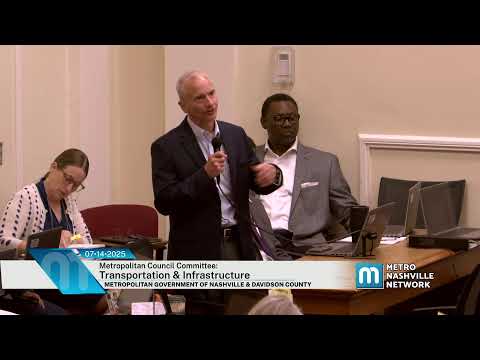
Metro Water Services told the Transportation Infrastructure Committee on Sept. 1 that it is updating the city’s stormwater inventory and master plan, a multi‑year effort to map assets, assess capacity and prioritize projects. Tom Palko, director of Metro Stormwater (Metro Water Services), said the department is about one‑third finished with a countywide inventory and expects to complete the master plan in 2028.
Why it matters: The inventory will give staff more precise information about pipes, inlets and pinch points and will be used to identify maintainence needs and capital projects that can be scheduled into the department’s six‑year capital plan. The work is intended to move beyond a simple conveyance inventory to include condition assessments, capacity evaluations and project scoping.
Palko told the committee the prior system inventory dates to about 30 years ago and that crews are surveying systems in detail, sometimes finding inlets or pipes that are not functioning. "The first time we did a stormwater inventory was 30 years ago," he said. Field crews are recording pipe sizes and conditions so staff can determine where the system is under‑sized and where projects will be necessary.
The department indicated that projects identified by the inventory will be funded from the stormwater user fee, which currently funds regular capital and operating work. Palko said the current annual project funding rate (roughly $10–15 million per year in recent practice, he said) will not be sufficient to fully retrofit older neighborhoods and that any accelerated program would require higher annual funding or bonded capital. He said the master‑plan work will produce estimates of the countywide need that the council can use to consider bonding or other funding mechanisms.
The department said it will continue to engage neighborhoods as specific projects are advanced to full design, and that it aims to spread projects across districts as feasible.
Ending: The stormwater inventory is part of a multiyear strategy to identify maintenance needs and capital projects; staff expect to complete the countywide master plan in 2028 and will return to council with project lists and funding recommendations.