
Clallam County ethics committee debates enforcement, due-process risks; schedules July 24 follow-up
Get AI-powered insights, summaries, and transcripts
Subscribe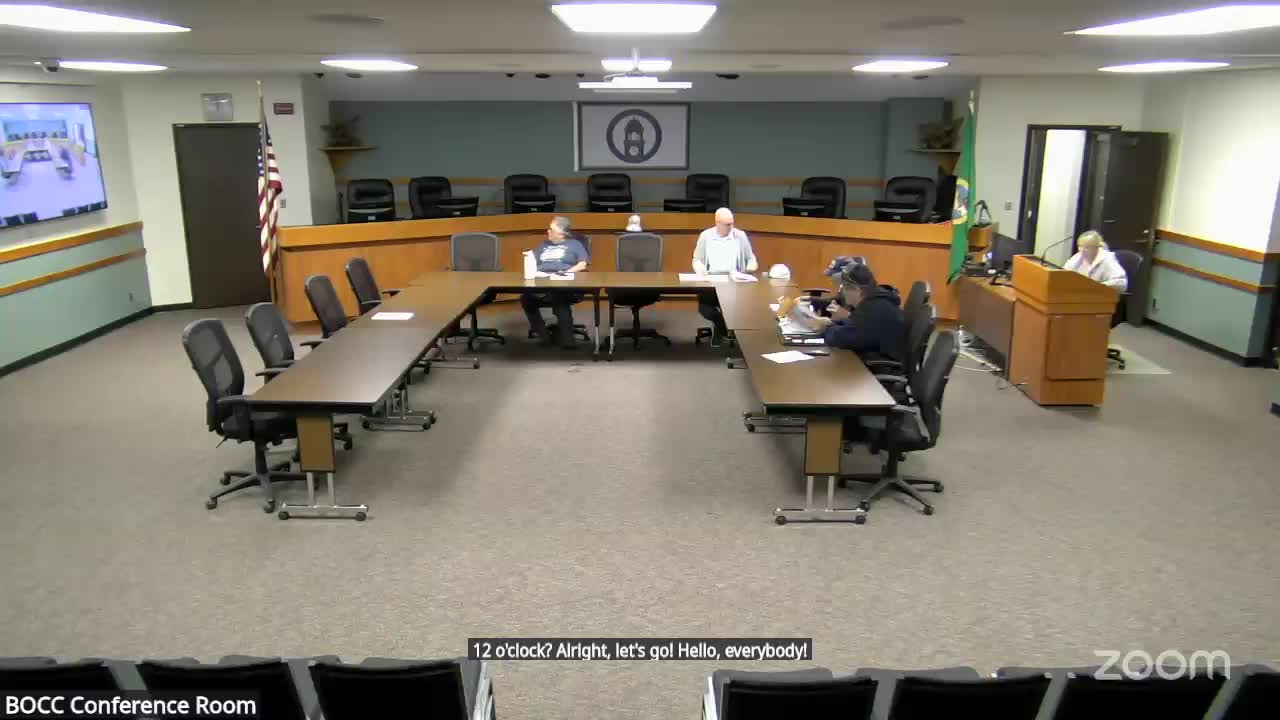
Summary
The Charter Review Commission—s Ethics Committee discussed whether to pursue a charter amendment to regulate elected officials— ethics, enforcement costs and due-process exposure, and agreed to research other counties before deciding; no ballot measure was placed and members set a July 24 meeting to continue work.
The Charter Review Commission—s Ethics Committee for Clallam County met July 3 to discuss possible changes to the county—s charter and code of ethics, but members stopped short of placing any amendment on the ballot and instead agreed to gather more information and meet again July 24 at 1 p.m.
The committee focused on three central questions: whether the county should add enforcement mechanisms for elected officials to the charter or code of ethics; whether outside examples (notably Clark and Pierce counties) offered workable models; and whether a formal finding or sanctions process would trigger costly due-process requirements. Ron Cameron, chairman of the committee and a District 2 representative, opened the meeting by noting the lack of outside legal input: "Dee will not be here today, but his report was that he had no report, that nobody had responded to his emails that he sent out." Cameron said that left the group without the county-prosecutor-level peer input it had hoped to use to shape a draft.
Why it matters: public interest and past incidents. A public survey cited at the meeting showed roughly three-quarters support for some kind of ethics oversight. Committee members and at least two public commenters described incidents they said illustrated gaps in current rules, including an example of a commissioner using his official role to oppose a local gravel-pit permit application. That example, raised by a committee member during the meeting, was framed as an ethical concern but not a criminal finding.
Discussion highlights
- Enforcement vs. practicality: Several committee members said the existing county code of ethics already covers elected officials on paper but lacks an enforceable mechanism for electeds. One member warned that creating a formal sanction process could require appointment of legal counsel and produce high legal costs; participants referenced prior out-of-county examples where enforcement efforts became expensive, with one speaker saying costs had been discussed "in the hundreds of thousands," though no specific case details were provided to the committee. The group repeatedly returned to the possibility that findings without clear procedural safeguards could trigger due-process and representation obligations.
- Narrower reforms with more traction: Committee members signaled more enthusiasm for narrower, targeted changes than for establishing a full disciplinary board. Multiple speakers supported a provision to bar county commissioners or department heads from serving on the boards of nonprofit organizations or other entities that receive county funds or contracts, to avoid the appearance of conflicts of interest. "If you have an NGO that is asking for a grant from the countyand the county commissioners are on the board of that NGOthat looks like there's influence there, and that can't happen," one member said.
- Outside models and legal input: The committee had planned to rely on research from the county prosecutor—s office and reach out to Clark County for its experience. That outreach had not produced usable responses by the meeting, and committee members volunteered to contact retired county officials, former charter commissioners, and local city contacts to gather firsthand accounts. Committee members also asked staff to research whether existing insurance (director-and-officer or risk-pool coverage) would cover any liability or costs tied to an ethics board. "It would be something to maybe ask fordirector directors officers and entity liability coverage," Dr. Sarah Huling, a member of the public, told the panel.
Public comment
Two people who joined the meeting online addressed the committee. A caller who identified himself only as John urged the committee to revert to an earlier form of the county—s ethics rules and raised broader political concerns; his remarks included claims about outside "global government" influences that the committee did not adopt as part of its deliberations. Dr. Sarah Huling, identified as a West End resident, recommended the committee examine the county's liability coverage and noted that some local entities exclude ethics committees from D&O protection. Committee members discussed how Clallam County participates in a joint risk pool for litigation and liability coverage and said they would verify what is and is not covered.
Decisions, directions and next steps
- The committee set its next in-person meeting for July 24 at 1:00 p.m. and agreed members should gather additional information before that date. - Members and staff were directed to attempt outreach to Clark County charter reviewers and other peer contacts, to ask the prosecutor's office for legal guidance on due-process exposure, and to check the scope of D&O/risk-pool coverage for potential ethics bodies. Several members volunteered to contact retired county employees and former charter commissioners. - The committee agreed not to pursue recall or monetary-penalty mechanisms at this stage; those options were discussed and explicitly removed from consideration earlier in the committee's drafting process.
No formal charter amendment or ballot referral was drafted or approved at the meeting. Committee members repeatedly stressed the difficulty of completing a legally sound, enforceable charter change before the November ballot and emphasized the need for more detailed legal and financial information before moving forward.
Looking ahead
Committee members said they remain open to a limited set of changes (for example, prohibiting commissioners from serving on boards of organizations that contract with or receive grants from the county) while avoiding a full sanctions regime that could trigger due-process litigation. The panel will reconvene July 24 to review findings from the outreach and insurance research and to decide whether to draft language for a future charter amendment or for recommendation to the full Charter Review Commission.