Get Full Government Meeting Transcripts, Videos, & Alerts Forever!
Get email alerts on the Climate Action Plan Public Hearing topic
No spam. Unsubscribe anytime.
Ithaca commission weighs public-hearing schedule, housing electrification and cooling measures to meet DEC grant deadline
Summary
Ithaca City Climate Action Commission members debated public-hearing format and timing required by a DEC grant, discussed housing recommendations (electrical-panel upgrades, flood-resistant construction, home-energy scores), and highlighted public-health and emergency-preparedness links such as cooling centers and an emergency-management grant.
Rebecca, a city staff member, told the Ithaca City Climate Action Commission that the city must hold at least one public hearing on the draft climate action plan to meet a DEC grant deliverable. "It is one of the deliverables, for the DEC. And in order to receive all of that funding, part of that process is that we have to have at least 1 public hearing on the climate action plan," she said, adding the agency "is not particular about it" beyond the requirement that it be called a public hearing.
Staff framed the timeline as tight: the commission was told the plan should be brought to the Ithaca City Council by October (with formal adoption no later than December) if the city wants to secure reimbursement tied to the grant. Commissioners debated formats — a single formal hearing, an online listening session, or a two-stage approach combining an earlier informational open house (for example at the public library) and an online comment period, followed by a formal public hearing. "I think it'd be great to have 2 events," the commission chair said, recommending an informational event early and a later formal hearing. Several commissioners warned that presenting to council during October could conflict with council's budget work and risk delaying adoption and jeopardizing roughly $100,000 in grant funding, which staff described as the potential cost of missing the deadline.
Commissioners discussed outreach format options used in past planning efforts: library open houses with stations and sticky-note comment collection; hybrid or online formats; and targeted informational sessions for council members. Rebecca said she would draft one or two public-hearing options for the commission to consider by email and would compile public feedback to submit with the commission's recommendation to council. "What I would suggest we do ... is compiling all the feedback that we get from the public and submitting that as part of the recommendation to council," she said.
Housing and building measures were a major focus of the conversation. Commissioners discussed a proposal to require electrical-panel capacity and other measures to make buildings "electrification ready" and to avoid forcing a building owner to make multiple costly upgrades at once if state mandates arrive later. Rebecca explained the aim is to "tick some of these boxes over the course of 5 years as opposed to … year 1" so electrifying and panel upgrades can be staged. Commissioners raised equity and technical concerns: panels in basements or in flood-prone areas could make upgrades wasteful; flood-zone rules already constrain new construction; and enforcement capacity for any new code obligations is limited. Staff offered a rough cost estimate for a panel upgrade at about $1,500, while noting incentives and income-based assistance could lower net cost for some owners.
Public health and emergency preparedness also figured prominently. Commissioners asked the plan to address cooling centers, indoor-air quality, and the interaction of heat events with air-quality or grid outages. "If it's over 90 degrees, you should not be using fans," Rebecca said, citing recent CDC guidance she had reviewed; central cooling or heat-pump-based solutions may be necessary to meet any future maximum-temperature standards. Commissioners stressed bundling measures where feasible — for example, elevating mechanicals to reduce flood-insurance costs while electrifying equipment — and called for stronger regional coordination on water quality and resilience. Rebecca reported the office had submitted a grant application for a joint emergency-manager position with the town and county that could help with interjurisdictional planning.
Why it matters: The commission's choices about outreach and the content of the climate action plan will determine whether the city meets a DEC grant condition and secures reimbursement. Housing and public-health measures discussed in the planning document carry regulatory, equity and cost implications for renters, landlords and low-income residents; commissioners emphasized implementation feasibility and regional coordination.
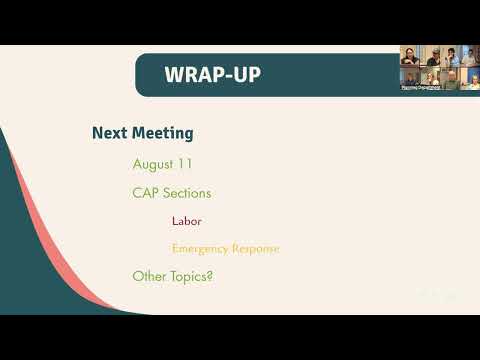
What’s next: Rebecca said she will produce options for public hearings, compile public feedback and include that compilation with a commission recommendation to council. The commission plans further review of remaining chapters at upcoming meetings before finalizing its recommendation to council.