Get Full Government Meeting Transcripts, Videos, & Alerts Forever!
Get email alerts on the Beltline Ssd Audit topic
No spam. Unsubscribe anytime.
Performance audit finds BeltLine SSD collections ahead of projections; committee holds report until BeltLine staff can appear
Summary
A performance audit found Service Special District (SSD) collections exceeded consultant projections and debt-service needs; Atlanta BeltLine, Inc. spent most bond proceeds on three trail segments but reporting to council lacked SSD‑specific data. The committee voted to hold the audit record until ABI can respond in person.
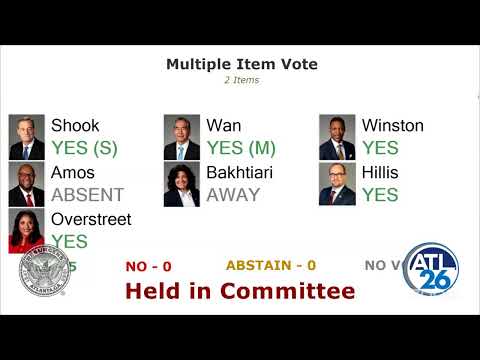
City performance auditors presented a financial review of the Atlanta BeltLine Service Special District (SSD) and told the Finance and Executive Committee on July 16 that SSD tax collections have materially exceeded consultant projections and annual debt‑service needs, but that Atlanta BeltLine, Inc. (ABI) has not been reporting detailed SSD data to the council. Tia Farrar, a performance auditor on the engagement, summarized collections and spending from June 2022 to June 2024. The audit found SSD collections of $3,200,000 in FY2022, $6,600,000 in FY2023 and $7,600,000 in FY2024, for $17,500,000 collected as of June 2024; auditors said those receipts were roughly five years ahead of the consultant’s projections. The audit also reported $36,000 in interest and penalty fees in 2023 and 2024. The audit reviewed bond proceeds and spending. The bond authorization was for $88,100,000 in proceeds; ABI had spent $61,700,000 as of February 2025 on the Northwest, Southside and Westside trail segments and the audit estimated about $20,000,000 of bond proceeds remained. The audit noted the bond agreement requires the Atlanta Urban Redevelopment Agency (AURA) to set aside $5,300,000 in a debt‑service reserve fund. Auditors sampled 30 vendor invoices for work completed January 2024–February 2025 and found the sampled invoices complied with guidelines for allowable SSD expenses and showed consistent documentation and approvals. The audit also reviewed prior recommendations from a 2022 report: three recommendations (create an MOU; update procurement and chart‑of‑accounts entries to include SSD language; update chart of accounts) were implemented and a fourth recommendation — that ABI provide an SSD reporting framework in an MOU with specific SSD data for council (tax collections, project completion status and discretionary fund details) — was only partially implemented. Farrar said the audit team issued a single recommendation to ensure council receives the detailed SSD information it needs for decision making; the COO, ABI and Invest Atlanta agreed with the recommendation and ABI is working with Invest Atlanta to include relevant SSD information in future reports. Committee members asked for ABI staff to appear to answer governance and spending questions. Councilmember Juan (as recorded in the meeting transcript) moved to hold the audit record until ABI staff could attend a future meeting; the committee voted to hold the item and direct ABI to appear. The motion passed: roll call recorded six votes in favor and no recorded nays. Committee members said they will follow up on how excess SSD collections are being used and on geographic prioritization of bond spending.