Get Full Government Meeting Transcripts, Videos, & Alerts Forever!
Get email alerts on the City Budget topic
No spam. Unsubscribe anytime.
Cocoa manager presents balanced $195 million budget; staff and consultants recommend steady millage and modest utility increases
Summary
City Manager Witten presented a balanced FY2026 budget proposal and Stantec’s financial analysis recommending the current millage be maintained, a 3% annual increase to the fire assessment, 4% annual increases for water and sewer, and no stormwater increase for FY2026.
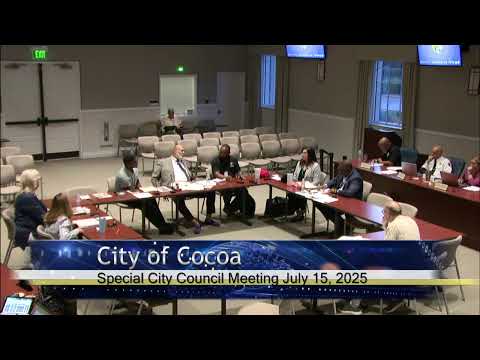
City Manager Witten on Tuesday presented a balanced FY2026 budget proposal and a financial outlook showing the city can hold its current property tax rate while covering planned operating and capital needs without drawing on general-fund savings. Stantec consultant Peter Napoli told the council his 10-year model supports keeping the millage rate steady and applying modest, phased increases to enterprise and special-assessment rates.
The budget proposal totals approximately $195 million, roughly 12% higher than the prior year, driven mainly by utility capital work. The general fund is about $52 million. Witten said taxable value rose about 6.1% this year to nearly $1.9 billion, and that water-utility revenue remains “our financial lifeline,” covering an estimated $22 million–$24 million that helps fund general government services.
Stantec’s analysis, presented by Napoli, recommends: continuing the current millage (6.9532), 3% annual increases to the fire assessment, and 4% annual increases to water and sewer rates. Napoli said the 4% glide path on utilities is intended to maintain reserves, fund cash capital and meet debt-service coverage needs: “that’s what’s necessary for a sustainable plan,” he said. For stormwater, Stantec recommended no increase for the FY2026 assessment but cautioned that a return to 4% increases could be needed in subsequent years depending on capital needs.
Why it matters: the city manager emphasized that the budget is structurally balanced without using general‑fund balances for capital next year and that the city’s tax base and utility revenues drive long‑term flexibility. Witten told the council the proposal includes competitive pay adjustments (generally in the 6%–8% range) and a small number of additional positions intended to keep service levels as the city grows.
Key details and next steps: Witten and staff said the proposed millage will appear on the tentative millage notice in the property-appraiser mailings tied to the Truth in Millage (TRIM) process; the council will set the tentative millage on July 22 with two hearings scheduled in September to finalize the rate. Napoli and staff said the general‑fund capital plan averages about $2.3 million per year after carry-forward projects, and that Stantec’s 10‑year forecasts assume no new recurring service levels beyond what is included in the FY2026 proposal.
What the council asked: members sought detail on reserve targets, taxable‑value assumptions, and how much future growth is included for planned subdivisions and the Intermodal Station. Napoli said his taxable‑value assumptions include a conservative blend of existing growth and an allowance for new construction; if capital costs or new projects grow beyond current assumptions, he said the model would be revisited to advise higher rate increases.
Discussion vs. decision: the council did not vote on rates Tuesday; staff presented a proposed balanced budget and recommended rate plan. The council directed staff to return the tentative millage as scheduled and to bring any requested follow-up material to the July 22 meeting so members can consider adjustments before the September hearings.
Ending note: the proposal prioritizes sustaining reserves and funding required utility projects while recommending measured, recurring rate steps rather than taking reserves or large one‑time measures to meet capital needs.