Get Full Government Meeting Transcripts, Videos, & Alerts Forever!
Get email alerts on the Behavioral Health Funding topic
No spam. Unsubscribe anytime.
County staff propose $1.67 million in ongoing behavioral health spending; one-time solvency funds flagged
Summary
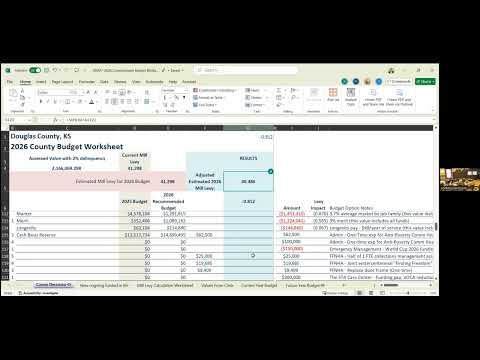
County staff on July 16 presented a detailed draft of behavioral health fund allocations for 2026 that included about $1,672,000 in new ongoing operational funding and several one-time allocations drawn from fund balance and solvency reserves.
County staff on July 16 presented a detailed draft of behavioral health fund allocations for 2026 that included about $1,672,000 in new ongoing operational funding and several one-time allocations drawn from fund balance and solvency reserves.
Why this matters: the behavioral health sales tax funds programs for mental-health and substance-use services; decisions about which services are paid from the sales tax fund versus the general fund affect both ongoing capacity and the appearance of dedicated funding to community partners.
Brooke, a county budget staff member, told commissioners “this adds an additional 1,672,000 in ongoing operational funding in the behavioral health fund.” The worksheet lists a $1,000,000 ongoing allocation labeled for “crisis system operations,” $321,032 for ongoing expenses related to a permanent supportive housing project, $104,400 for DECA client tenant-based rental assistance, and other ongoing allocations such as funds to support substance-use disorder treatment and supportive housing case management.
Staff also identified one-time items charged to fund balance or solvency reserves: a $500,000 one-time allotment for Bert Nash and other listed one-time amounts described in the worksheet. Brooke noted staff would label those items clearly and that one-time uses do not change the mill levy because they would be spent from fund balance.
Commissioners and staff discussed the fund’s policy status. Sarah, county staff, told the board the segregation of a behavioral health fund is a policy choice rather than a statutory requirement, saying the county “is not required by state statute to do it. We just have done it to be sort of respectful of that dedicated sales tax.” Commissioners asked staff to clarify the behavioral health accumulated account balance and whether some one-time items should be moved to the general fund or kept as solvency reserves.
On procedural steps, staff said some items under discussion could be moved to the general fund to consolidate funding for particular partners. Commissioners asked staff to return with clarified line-item notes and to make sure community partners understand that solvency funds or contingency lines are not final obligations until contract or service agreements are executed.
Ending: Commissioners asked staff to reconcile fund-balance notations and to return with clearer labeling of ongoing versus one-time behavioral-health allocations in advance of public hearings.