Get Full Government Meeting Transcripts, Videos, & Alerts Forever!
Get email alerts on the Rezoning Sandry Dexter Lane topic
No spam. Unsubscribe anytime.
Commission approves R‑1 rezoning for Sandry/Dexter Lane with road‑improvement condition after access concerns
Summary
The commission rezoned two parcels on Sandry Lane and Dexter Lane from A‑1 to R‑1 for a 16‑lot single‑family development, subject to a condition requiring road improvements (20‑foot width) along Sandry Lane; developers agreed to widen Dexter where needed to accommodate emergency access.
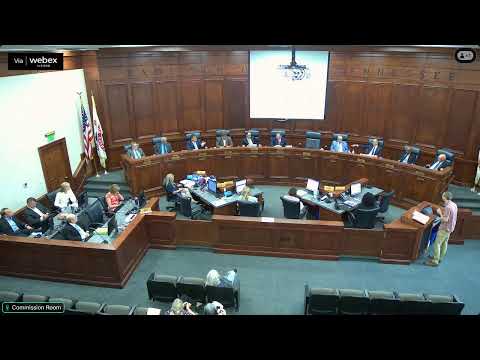
Hamilton County commissioners on July 16 approved rezoning for properties at 2925 Sandry Lane and 2927 Dexter Lane from A‑1 agricultural to R‑1 single‑family residential with conditions that require road improvements.
The planning commission recommended approval with a condition to improve Sandry Lane to a 20‑foot width where it borders the proposed development. Staff’s initial recommendation had been to deny because the proposed rezoning increases density along the road, but the planning commission and the applicant agreed on additional roadwork. County planners explained the existing roadway does not meet county public‑road standards in width and compaction.
At the meeting, the applicant’s engineer, Joseph Ingram of Ingram Gore & Associates, said the developer agreed to widen Sandry Lane to provide a 20‑foot right of way on the segment adjacent to the property and to make needed improvements at the turn where Sandry connects with Dexter Lane. “We will widen and give the 20‑footer right of way,” Ingram said. He added the team will perform survey work and, where necessary, dedicate right of way so the road meets county standards.
Commissioners and members of the public raised concerns about emergency‑vehicle access, the location of a carport that may intrude into the right of way, and whether Dexter Lane would be widened. Planning staff said the developer agreed to widen additional segments beyond the property’s frontage and to build a new road segment in places where the existing alignment does not meet standards.
Why it matters: County staff said the site plan proposes 16 lots (density about 4.4 dwelling units per acre). Planning staff noted that, under current A‑1 zoning, the property could be developed at a lower density (roughly nine units), so rezoning increases density and triggers road‑improvement conditions.
Public comment: Neighbors were sent letters as part of the zoning notice; no property owners spoke in opposition at the planning commission and one resident attended the commission meeting to ask about neighborhood outreach and process. Commissioner Baker abstained from the vote, stating a personal connection to the applicant; the rezoning passed with the remaining commissioners voting yes.
Next steps: If the rezoning is developed, subdivision plats and final engineering will be required. Survey work and right‑of‑way dedications will have to be completed before the county accepts road improvements as meeting public‑road standards.