Get Full Government Meeting Transcripts, Videos, & Alerts Forever!
Get email alerts on the Housing topic
No spam. Unsubscribe anytime.
New Iberia council amends mobile-home park standards; adopts operational rules, limits on older units
Summary
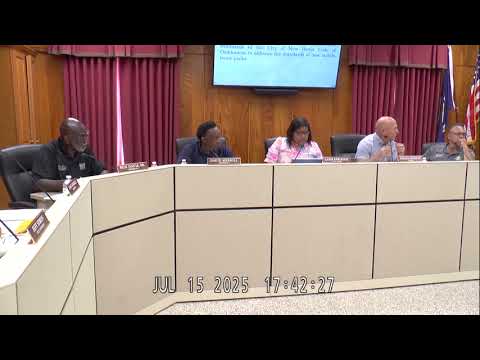
The New Iberia City Council advanced an amended ordinance on mobile-home parks that tightens construction and operational standards for new parks and establishes several operational requirements that will apply citywide.
The New Iberia City Council advanced an amended ordinance on mobile-home parks that tightens construction and operational standards for new parks and establishes several operational requirements that will apply citywide. Councilors discussed road, sewer and trash rules, the allowable age of mobile homes, parking and skirting materials, and whether and how to treat existing parks before voting to adopt the amendments. The ordinance (No. 2025-18) rewrites the city’s Article 2, Division 3 of the Code of Ordinances that governs mobile-home parks. Council members framed the revisions as a package: building and subdivision standards would apply to new parks, while operational standards and selected requirements would extend to existing parks or be addressed later in a separate amendment. Council members and staff emphasized that new mobile-home parks must build streets of concrete or asphalt and meet subdivision or permitting requirements where public facilities (sewer, hydrants, detention) are required. The council clarified that if a new park is built where city sewer is available and capacity allows, developers may connect to those lines; otherwise developers must pay to provide sewer as with other developments. The council also retained an annual inspection regime to identify maintenance issues and require corrections through the city’s compliance process. Members debated whether to apply building standards to existing parks immediately or to grandfather older parks. To resolve that question the council amended the division so it applies to all mobile-home parks but specifies that building standards apply only to new parks; operational standards apply more broadly. Council members asked staff to return with language addressing nonconforming uses and the one-year replacement window for individual mobile homes on a lot. Key numeric and operational clarifications the council included in the amended ordinance or discussed for follow-up: a 10-year or newer maximum age for mobile homes brought into parks (councilors said this could be applied to new and, in some cases, existing sites by separate action); maximum density listed as 12 units per acre; parking stall depth of 26 feet where measured from the back of curb for on-street sites; and a requirement that receptacles and dumpster locations be on private park property rather than in city right-of-way. The council also removed and consolidated language that would have required the city or the park owner to provide shared cups or common restroom maintenance, saying such provisions do not match current practice. Council members also debated operational enforcement and manager qualifications. A provision that would have required the manager to meet a character standard was deleted after members said the council should not act as a moral arbiter; they indicated compliance enforcement is the proper mechanism to address poor management. The council left operational rules (maintenance, trash, skirting options and container placement) in the ordinance and directed staff to bring back clarifying language on private versus public roads and on how nonconforming single-unit replacements are handled. After discussion the council voted to adopt the set of amendments. The meeting record shows a motion to amend made by Councilman Troy Como and seconded by Councilman David Merrill; later the main motion to approve the amended ordinance was made and seconded and the council voted by machine. The transcript does not include a numerical roll-call tally in the public record excerpt provided. The council directed staff to draft follow-up language addressing existing-park operational standards, nonconforming uses and the procedural language needed to implement the 10-year maximum on replacement units where the city intends it to apply. Staff also was asked to clarify definitions used in the ordinance—especially the distinction between private and public roads and when a site must return to council for plat or zoning changes. The council said compliance staff would remain the primary enforcement arm for operational violations. The amended ordinance now sets the policy framework for how new mobile-home parks will be built and inspected and creates a path for later actions to address existing parks’ operational and compliance problems. Ending: The council said it will return with drafting changes and clarifications at a future meeting and will keep work on existing-park standards separate from the immediate package for new parks until staff presents nonconforming-use language and a clear enforcement path.