Get Full Government Meeting Transcripts, Videos, & Alerts Forever!
Get email alerts on the Water Quality topic
No spam. Unsubscribe anytime.
Fall River officials report stable Watuppa reservoir levels; cyanobacteria advisory remains
Summary
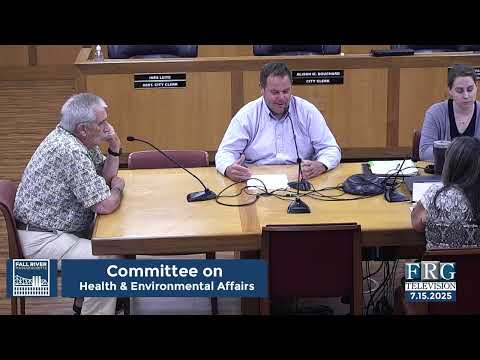
City and Watuppa water officials told the City Council Committee on Health and Environmental Affairs that reservoir levels are within target ranges, a long‑standing cyanobacteria advisory remains in place and intermunicipal cooperation with Westport and Tiverton continues to be informal rather than regulatory.
Fall River officials reported July 15 that reservoir levels at North and South Watuppa ponds are within seasonal targets but that a 2018 health advisory for blue‑green algae (cyanobacteria) remains in effect.
Paul Furlan, administrator of community utilities for the City of Fall River, told the City Council Committee on Health and Environmental Affairs that “as of today, North Watuppa top of pond is negative 15 inches, 15.5 inches below full pond, which halfway through July is a very good position to be in.” He said South Watuppa was “20.6 below full pond,” improving from about 26 inches below full earlier this season.
The report matters to residents and recreational users because city staff consider a South Watuppa range between 18 and 24 inches below full pond a good balance between protecting waterfront properties and allowing boating, Furlan said.
Furlan said the Copacup pump has been operating since about July 2 to transfer water into North Watuppa to help maintain reservoir levels. He also warned that warm weather and watershed runoff can increase nutrients and lead to algal growth: “Since 2018, there has been a…health advisory in relation to blue green algae and cyanobacteria. So that was put in place in 2018 and has not been lifted.”
Councilor Breyer asked about coordination and enforcement with neighboring communities that share the watershed, specifically Westport and Tiverton. Furlan said the city and the two neighboring towns entered an intermunicipal agreement in 2020–21 to cooperate on improving South Watuppa water quality but that the agreement does not include enforcement measures on fertilizer use or docks; its primary focus is shared use of water and cooperative study and management. “There was nothing in there specific to what type of fertilizer they use, what ramifications,” Furlan said.
Furlan and Jim Theriault, president of the Watuppa Water Board, said public outreach has included several meetings with Westport and Tiverton residents and notices on the water department website. Furlan said a watershed mailing could be useful but would carry a significant cost and would depend on whether the neighboring municipalities would share expenses.
Theriault described storm cleanup after a July storm that brought down large trees in the reservation and across the interceptor drain; crews cleared emergency access to the water treatment plant and the lines and trails used for maintenance. “The fellows that responded to clean out the downed trees on the interceptor did an outstanding job,” Theriault said, adding that several large oak and maple trunks will be sold under wood permits.
Furlan said residents may apply for a wood‑cutting permit to remove downed material; he said designated permits cost “I believe it’s $40 for residents.” He said the department will select which downed, dead timber can be taken and that inspectors will not allow clear‑cutting.
The committee also discussed permitted uses in the city reservation, including motorized conveyances. Furlan said off‑road motorized use is not allowed in reservoir lands; Chapter 90 roadways and marked state dirt‑bike trails in nearby Freetown State Forest are the appropriate places for motorized recreation. He noted state rules and classifications for e‑bikes can vary by trail type and that the city’s mountain‑bike trails are nonmotorized.
No changes to regulation were adopted at the meeting. The committee lifted from the table a resolution to convene a quarterly review of the water supply and water filtration plant (the resolution had been tabled Jan. 28, 2025) and later voted to table further action on the agenda at the end of the session.
The discussion also touched on grants and treatment options for cyanobacteria: Furlan said a federal earmark for treatment similar to work done at Stafford Pond reached late stages in the budget process but did not survive final appropriations, and that such treatments typically have a limited useful life and may require retreatment or broader watershed fixes.
The committee’s water items will return for future review as staff continues outreach with neighboring communities and monitors reservoir levels and pond health.