Get Full Government Meeting Transcripts, Videos, & Alerts Forever!
Get email alerts on the It Modernization topic
No spam. Unsubscribe anytime.
Arapahoe County IT seeks multi-year modernization funding; highlights Google contract, cybersecurity, and enterprise software needs
Summary
Arapahoe County Information Technology presented a multi-year modernization plan and near-term "must" investments including cybersecurity upgrades, enterprise application modernizations, and staffing increases; commissioners asked IT to return with refined cost ranges for CIP and operating requests.
Arapahoe County IT delivered a broad study-session outlining immediate and multi-year technology investments it characterized as "musts," "shoulds," and "coulds." Department leaders framed the request as necessary to prevent a significant operational gap caused by deferred upgrades, expiring contracts, and rising vendor costs.
Immediate priorities IT presented included: planning for Google contract changes (a multi-year move with a five-year total cost projection), an enterprise replacement for the assessor/treasurer (a capital-scale implementation with large one-time and subscription costs), endpoint security and remote-browsing protection (Zscaler or equivalent), a new IT service-management (ticketing/asset) platform to replace Cherwell, content-management replacement and digital accessibility remediation funding, emergency notification and shared-device licensing tied to the county phone-system migration to Teams, and professional services for Salesforce-based custom applications used by county partners.
IT emphasized the department's operational scale (180+ applications supported, 700+ terabytes of storage, 33 network locations, 3,000+ devices) and current gaps: staffing capacity to deliver projects, cybersecurity toolset shortfalls, and deferred investments that could create single-point failures. The department proposed incremental staffing increases (project managers, custodial IT support for AV, junior engineers, and additional voice/contact-center staff) and creation of a technology modernization fund to smooth capital and subscription cycles across years rather than funding one-off major projects.
Commissioners and staff asked for more granular budget pack details for CIP and operating asks and stressed the need for ranges and options (e.g., hybrid versus gas fleet analog in other departments). IT agreed to refine cost estimates, tie projects to CIP submissions where applicable, and present clearer ROI/total-cost-of-ownership comparisons for large requests (e.g., assessor/treasurer platform, Teams/E5 licensing tradeoffs vs. third-party security tools).
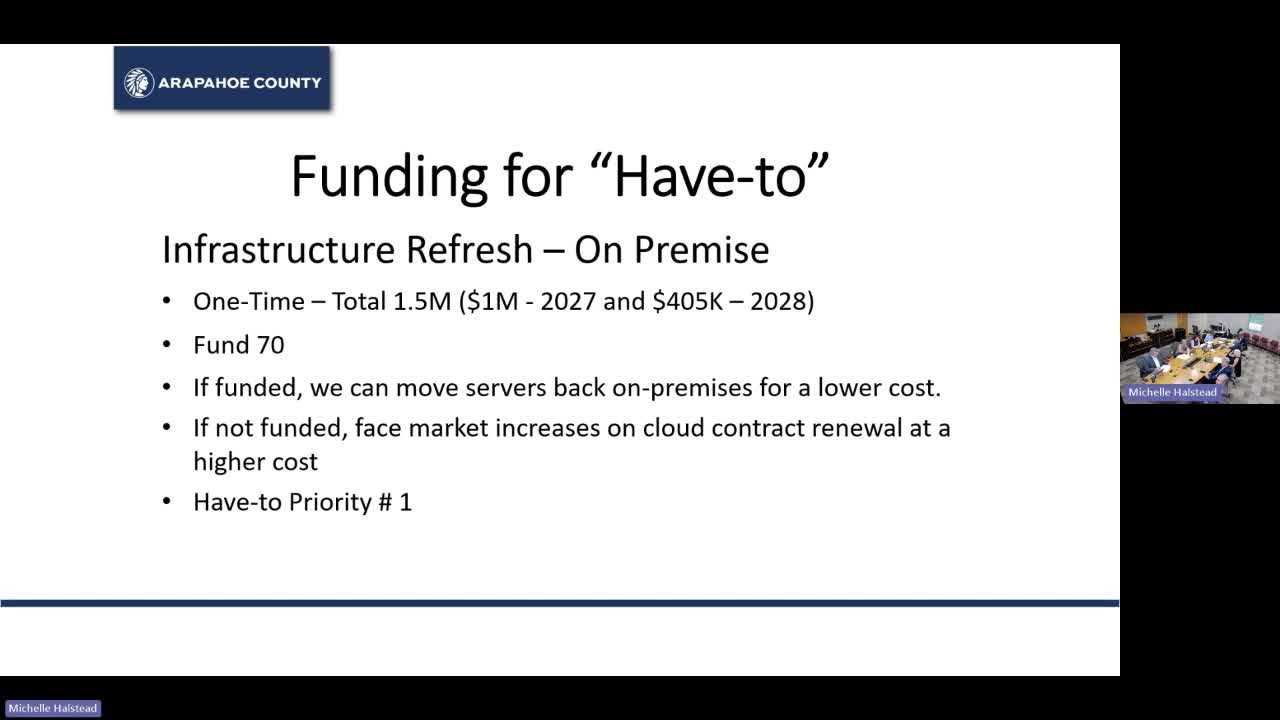
IT's leaders also noted ongoing efforts: endpoint protection grant support from the state, partial funding for AV and cameras to be moved into fund 70, and concerns about long-term operational costs as the county shifts from capital to subscription-based software. IT asked the board for early feedback on prioritization of projects as IT prepares formal 2026 budget packets and CIP entries.