Get Full Government Meeting Transcripts, Videos, & Alerts Forever!
Get email alerts on the College Budget topic
No spam. Unsubscribe anytime.
College officials brief Columbia County panel on budget, enrollment and program plans
Summary
College staff presented a preliminary budget overview to the county education subcommittee, covering tuition and fee changes, prison education enrollment, the SUNY Reconnect initiative, foundation support and planned investments in technology and nursing simulation to expand clinical capacity.
College staff presented a first-round budget overview to the Columbia County education subcommittee, outlining tuition and fee adjustments, projected enrollment changes and planned one-time and operational investments.
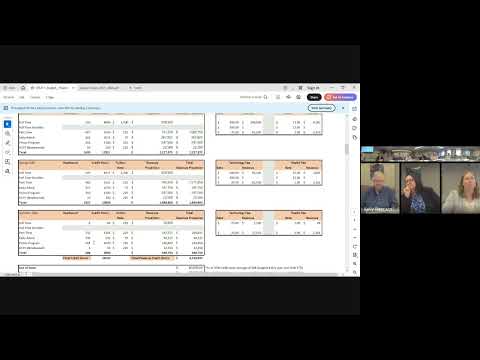
The presenter told the panel the college will hold tuition flat for students while increasing certain service fees, raising the full-time student service fee from $170 to $300. The presenter said the college’s enrollment forecasting group applied a 10% conservative reduction to prison-education headcount for the coming year “to buffer it for the prison education revenue.”
The budget presentation emphasized several revenue and cost drivers. The presenter said the college had been able to retain most students affected by a recent strike at the prisons after obtaining a permission from the state education department to extend the semester for the prison program. “We lost only a few who either moved or through various reasons needed to drop their courses,” the presenter said, and noted that keeping those students in spring terms preserved about $1 million in revenue compared with canceling the semester.
Why it matters: the college is trying to stabilize revenue after enrollment declines and to fund targeted, often-startup initiatives using a mix of state aid, foundation commitments and one-time grants. The county, as a major sponsor and stakeholder, sought detail on enrollment splits, fund balance and which foundation commitments are recurring versus startup funding.
The presentation covered specific funding lines and planned investments. The presenter said the college expects an allocated state appropriation tied to community college FTEs and a $175,000 state grant this year for mental-health and health-science uses. The college is also seeking multi-year foundation support for a Center for Innovation in Teaching and Learning and for a dean of health professions; the presenter described those as second-year foundation commitments intended to seed new work rather than permanent operating subsidies.
Planned technology and administrative investments described in the presentation include a move to Slate (an admissions CRM under a SUNY state operating contract) and additional software for student experience and human-resources management. The presenter described a foundation request that would cover initial implementation costs and said recurring licensing costs should decline in later years as older systems are retired. The presentation also listed proposed one-time IT items (firewall replacement, network switches), simulation and virtual-reality equipment for nursing, and new recruitment/marketing tools.
Nursing and workforce priorities featured prominently. The presenter said the college intends to expand registered-nursing seats from a 62-entry cohort to 75 in the 2025–26 academic year, and gradually to 100, contingent on clinical capacity and approvals. The college plans to launch a 20-seat LPN cohort when state approvals and clinical placements permit. To reduce reliance on clinical placements, the college plans to scale simulation to the maximum permitted by regulation (the presenter noted the law now allows up to 30% of clinical hours to be simulated; the college currently uses under 5%). The presenter said those simulation investments are tied to planned seat expansions.
Other points raised to the committee: the SUNY Reconnect program (state policy to provide tuition assistance targeted to adult learners) may bring additional adult-student demand but is limited by program eligibility and by which fields qualify as “high-demand” under the state definition; the presenter listed automotive, computer science, environmental biology, cybersecurity and nursing as local matches. The presenter also flagged operational items such as continuing-education staffing and a new grant-manager position to pursue federal and state grants, and said the college will refine categorical fees that apply to all students (technology fee, health fee, program-specific malpractice fees).
Committee members asked for more detailed breakout materials for members to review in advance, including a clearer per-line breakdown showing where savings and additions were made. The presenter agreed to provide more granular budget breakout and to invite institutional research staff to future meetings to explain enrollment trends and the split between incarcerated, dual-enrolled high school and county-resident students.
The meeting produced no formal county action on the college budget at this session; the presenter and committee discussed next steps and follow-up reporting.
Ending: Committee members indicated they want quarterly or at least annual deeper dives—particularly from institutional research staff—so the county can better track enrollment shifts and how foundation and state funding interact with county support.