
State opioid intervention court team proposes rapid-response court for Columbia County
Get AI-powered insights, summaries, and transcripts
Subscribe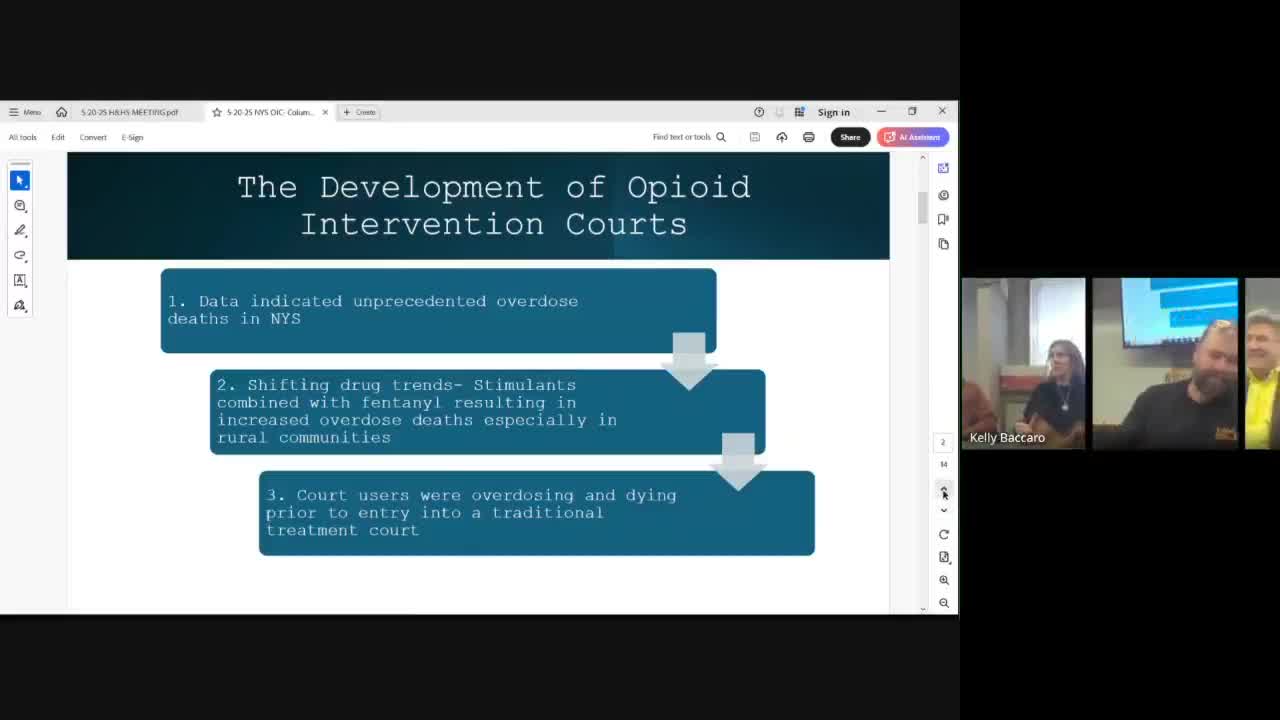
Summary
New York State Unified Court System staff presented a pre-plea opioid intervention court model to Columbia County supervisors, saying federal and state grant funding would cover startup costs and that a development workshop is set for June 23.
Susan McCaffrey, a statewide opioid court project director with the New York State Unified Court System, told Columbia County supervisors on May 20 that the system is seeking to establish an opioid intervention court in Columbia County using federal grant funds and state resources.
McCaffrey said the opioid intervention court is a pre-plea, voluntary triage model designed to stabilize people at high risk of overdose immediately after arraignment. “We were just looking to do that immediate intervention to connect folks to critical life saving care at the point of arraignment,” she said.
The model grew from a 2016 pilot in Buffalo and was later evaluated with independent researchers. McCaffrey summarized the results: participants in the intervention court were, in the study cited, half as likely to die within one year as comparable individuals who did not participate, and connecting participants to medication within the first 14 days was associated with a similar reduction in mortality. The pilot also produced an estimated cost savings of about $300,000 per participant, she said. Those findings and other expert input led to national guidance the presenters used in designing courts.
Why it matters: Columbia County has overdose rates higher than state and national averages, presenters said. The program aims to supply a short-term (typically about 90 days) stabilization period focused on rapid access to medication for opioid use disorder and peer supports, rather than a long-term court-supervised treatment sentence. McCaffrey said prosecution is typically suspended during participation and that failure to complete the short program would only resume the underlying case rather than trigger additional penalties.
County-level implementation details remain under development. McCaffrey said the federal grant funds eight rural opioid intervention courts statewide and Columbia County is one candidate; the project team has already completed data analysis and resource mapping and held one development workshop in April. A second workshop is scheduled for June 23 to work through procedural logistics — for example, how town and village arraignments can be routed quickly into the county-level intervention process. McCaffrey said the court would be housed in the county court but that referral pathways from town, village and city courts are being discussed so people can be connected as rapidly as possible.
County staff said they do not expect a direct cost to the county for startup because the initiative is supported by federal grant funds and state treatment-court resources. McCaffrey said the grant-funded model also includes a funded certified recovery peer advocate dedicated to the court.
Supervisors and staff discussed next steps: continued stakeholder workshops, drafting procedural agreements to allow rapid transfers from local arraignment courts, and soliciting letters of support from towns and local judges. McCaffrey said she hopes the Columbia program could be operational by late summer following the June 23 workshop, but that timing depends on completing the logistical and procedural work.
The county will host the June 23 workshop and invited interested stakeholders to attend. The presenters offered to share national guidance, the state center-of-excellence materials, and additional statistics with county officials who requested more detail.