Get email alerts on the Prescriptive Credits topic
No spam. Unsubscribe anytime.
TAG narrows prescriptive credit increases, approves revised square‑foot credit table
Summary
The Washington State Residential Energy Code TAG approved a revised residential credits table intended to steer the code toward the state's 2030 energy goals, adopting a new, size‑based approach and modestly adjusting renewable energy caps after debate over cost and equity impacts.
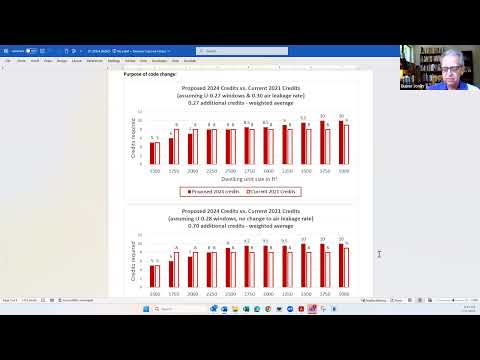
The Washington State Residential Energy Code Technical Advisory Group approved a revised prescriptive credits table for single‑family homes on June 27, 2024, adopting a size‑based credits staircase and a small adjustment to the renewable energy cap after extended debate about costs and feasibility. TAG members approved the modified proposal after voting to disapprove an alternate table earlier in the meeting. Why it matters: The credits table feeds the state's prescriptive compliance path, which many builders rely on to meet energy targets. The change is intended to help the state move toward its mandated energy reductions while recognizing differences in home sizes and technology options. The TAG considered two competing approaches to raising prescriptive requirements: a table created by Dwayne Johnlin that applies ten size categories and a formulaic approach offered by Patrick (last name on transcript). Members debated potential cost impacts for larger homes, how the changes affect multifamily and small additions, and whether the renewable energy credit (solar) cap should rise. - The approved table uses ten size buckets concentrated where most new homes are built (roughly 1,500–3,500 square feet), lowering credit requirements for many homes under 2,000 square feet and increasing them for the largest homes. The goal is an overall code trajectory toward about a 10 percent improvement target used in this cycle's policy discussions. - TAG members debated the solar (renewable energy) credit cap, and the table was adjusted so the renewable credit cap aligns with the updated prescriptive structure. The renewable cap discussed in the meeting was increased from 4.5 credits to 5 credits for larger homes; TAG approved a modification in the final table discussion reflecting a small increase to better match expected pathways to compliance. - TAG explicitly left certain occupancies unchanged: R‑2 (group residential) credits and credits for small additions were discussed and kept as exceptions in the table (the TAG asked the proponent to preserve those exceptions in the final posted language). What members said: - Dwayne Johnlin, TAG member and proponent of the size‑based table, framed the proposal as a data‑driven attempt to distribute credit requirements where most new home construction occurs: "It turns out that the vast majority of new homes are in that 1,500 to 3,500 square foot range," he said, adding the intent was to avoid large jumps in required credits at arbitrary size cutoffs. - Anne Anderson, energy engineer and TAG member, warned that high credit counts for very large homes will likely push builders toward rooftop solar as the only feasible compliance route: "At 10 credits, you're going to be mandating solar to get this to work, which is there's no flexibility in that," she said. - Larry Andrews, contractor, urged caution on timing and costs: "Material costs have doubled since COVID," he warned, saying the TAG should be mindful of affordability impacts in Eastern Washington. How the TAG voted and next steps: - The TAG disapproved the alternate formulaic proposal (Patrick's) in a roll call vote 12–1 with 4 abstentions. - After revisions and negotiations, TAG approved the size‑based prescriptive table with modest adjustments (motion carried by voice; one recorded opposition was noted in the transcript). TAG also approved a related modification to the renewable energy cap (five credits for large single‑family homes was adopted in discussions). - TAG members agreed the table will be posted in its finalized form for the next round of committee review and public comment (MVPE committee and then the State Building Code Council rulemaking sequence). The TAG directed that exceptions for R‑2 occupancies and small additions be preserved in the final language. Background and context: The prescriptive credits table is one of the main ways Washington enforces residential energy performance. TAG members repeatedly referenced the state's statutory glide path to increased efficiency (RCW 19.27) and the need to balance energy gains against home affordability and supply‑chain costs. Members also asked the modelers (PNNL referenced in the meeting) to provide final comparisons of the combined prescriptive changes and ERI changes during the public comment/modeling window so credit totals can be adjusted before the final rule. Looking ahead: The approved table will be included in the next round of public materials and reviewed by PNNL and other modelers as part of the public comment process; TAG asked for follow‑up modeling during the rulemaking period to confirm the aggregate effect on energy savings and to adjust credit values if needed. Ending note: The TAG emphasized this is an iterative, multi‑cycle process and members repeatedly urged careful documentation and further modeling in the public comment period to refine credit values and preserve affordability protections.
AI generated
The text on this page is AI generated. Summaries, highlights, analysis, and video transcripts are all produced from the original source material.
AI can make mistakes, so if you spot one, and we will fix it for everyone.
Note: the source content is unaltered by us. Any content source we link to, be it a video, an audio recording, or a document, is presented exactly as its publisher released it. That publisher is usually a government body, sometimes an individual official or another organisation.