Get Full Government Meeting Transcripts, Videos, & Alerts Forever!
Get email alerts on the Micro Mobility Regulation topic
No spam. Unsubscribe anytime.
Lake Bluff committee discusses proposed e‑bike and e‑scooter limits in downtown; staff to draft ordinance
Summary
The Village of Lake Bluff Committee of the Whole met July 14 and discussed a proposed ordinance to restrict certain electric personal vehicles in the Central Business District (CBD), with public‑safety concerns about fast, motorized “e‑motorcycles” cited by police and residents.
The Village of Lake Bluff Committee of the Whole met July 14 and discussed a proposed ordinance to restrict certain electric personal vehicles in the Central Business District (CBD), with public-safety concerns about fast, motorized “e‑motorcycles” cited by police and residents.
Chief of Police Matt Smazinski said the village has received numerous complaints and police observations of reckless operation in the CBD and elsewhere. “We’re here tonight for a proposed e vehicle restrictions in the Central Business District,” Smazinski said, describing a pattern of fast acceleration, wheelies and evasive riding by youths on motorized two‑wheelers.
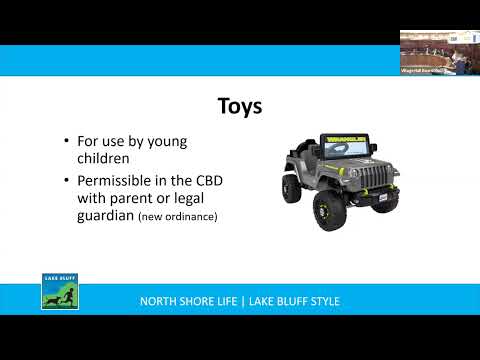
The discussion centered on three practical rules staff presented: (1) require all wheeled devices in the CBD sidewalks to be walked (“walk your wheels”), with narrow exceptions for very small children under adult supervision; (2) treat motorized bicycles and scooters as roadway vehicles under state law (i.e., not allowed on sidewalks); and (3) set a village‑wide speed cap for electric personal vehicles outside the CBD (staff and trustees discussed 20 mph as a working figure). Trustees expressed a preference for simple, easy-to-understand language in any ordinance.
Why it matters: trustees and residents said high-speed riding and evasive behavior create safety risks for downtown patrons, merchants and neighborhood pedestrians. State classifications and shifting legislation complicate local enforcement. Smazinski noted pending and recent state actions that affect definitions and enforcement; he cited Senate Bill 2285 as an example of changing statutory language that could alter how municipalities must treat certain low‑speed electric vehicles.
Discussion and enforcement issues
Smazinski explained that Illinois law currently recognizes different e‑bike classes (class 1, 2 and 3) and that some vehicles — especially throttle‑only models and heavier electric bikes built more like off‑road motorcycles — are difficult to distinguish visually from pedal‑assist bikes. “Those class 2 bikes can look like class 1, and unless you inspected, you may not realize that it's a class 2,” he said, adding that class‑3 operation carries higher age requirements under state law and that, by statute, many electric bikes must be operated on roadways rather than sidewalks.
Trustees repeatedly returned to a desire for a “dummy‑proof” ordinance that is easy for parents, riders and enforcement officers to understand. Several board members proposed a bright‑line approach: no riding on CBD sidewalks (walk your wheels), require motorized bikes to use roadways, and clamp down on reckless driving and unlicensed operation of motorcycles.
Public comment and local concerns
Residents described repeated close calls and what they called evasive behavior by young riders. “I saw 3 guys coming north on Vincent Court ... doing wheelies, and I just thought there's how do you enforce anything? I mean, they're gone in an instant,” said Chris Claywitter, a Lake Bluff resident. Another resident, Sid Smith, urged attention to who is operating the vehicles as well as where they are operated: “If any of us want to use a motor vehicle, we have to have a driver's license,” Smith said, arguing for guardrails that address riders’ training and age.
George Russell described seeing high speeds near the Gurney Avenue footbridge and said those incidents illustrated the risk of a serious accident. Carrie Stegmark urged clear, equitable rules and rider education, and asked the village to avoid over‑policing or unsafe confrontations between adults and children.
Outcome and next steps
No ordinance was adopted at the meeting. Trustees and staff reached a consensus to continue drafting simpler rules and to return with a workshop or revised draft for the full board and the public, coordinating with trustees who were absent. The committee also directed staff to consider signage and public education similar to measures used by nearby Lake Forest. Smazinski said enforcement will remain focused on reckless driving and on vehicles that are clearly motorbikes requiring registration and licensing under state law.
Votes at the meeting
The meeting approved routine minutes by voice vote earlier in the agenda and later adjourned by voice vote; no formal roll‑call vote was taken on the e‑vehicle proposal.
Ending
Staff will prepare a clearer draft ordinance and a public workshop was suggested so residents can review proposed language and signage before the Village Board considers formal adoption. The committee emphasized keeping CBD sidewalks safe for pedestrians while creating understandable rules residents can follow.