Get Full Government Meeting Transcripts, Videos, & Alerts Forever!
Get email alerts on the Subdivision Land Development Ordinance topic
No spam. Unsubscribe anytime.
Bethlehem holds public hearing on comprehensive SALDO update; council schedules readings, takes related votes
Summary
City staff outlined a multi-year, wide-ranging update to Bethlehem's subdivision and land development ordinance (SALDO), aligning review procedures with the city's climate action and comprehensive plans. Council took no vote on the SALDO at the hearing but later approved a package of budget and program resolutions and ordinances.
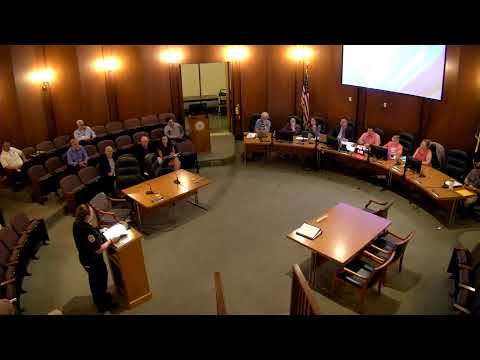
Bethlehem City Council on July 10 held a public hearing on a comprehensive update to the city's subdivision and land development ordinance, commonly called the SALDO, hearing detailed presentations from planning staff and public comment. No vote was taken at the hearing; the administration said the proposed ordinance will return to council for two readings beginning August 5.
The SALDO hearing matters because the current ordinance dates to 1975 and the proposed rewrite clarifies submission procedures, codifies climate and complete-streets practices, adds design standards for certain commercial and mixed-use zones, and formally brings Lehigh Valley Planning Commission reviews, the Bethlehem Environmental Advisory Council and LANTA transit review into the plan-review process.
Laura Collins, director of community and economic development, introduced the presentation and said the administration was "presenting a few revisions and updates to the subdivision and land development ordinance, which we will refer to as the SALDO." Planning Director Kathy Fletcher described the goals: "we really wanted it to reflect the current SALDO standards per the Pennsylvania Municipalities Planning Code," and to align the SALDO with the city's comprehensive plan and climate action objectives.
What staff described
- Scope and process: City staff and consultants told council the SALDO governs procedural and technical standards for subdivisions and land development: plan submission requirements, recording, streets and utilities design, sidewalks, street trees, lighting, stormwater, and the city's review and inspection steps. The SALDO does not set zoning uses, density or facade design standards that legally belong in zoning or historic regulations.
- Notable thresholds and definitions: The draft defines a major land development as projects that create 15,000 square feet or more of new impervious surface, 10 or more dwelling units, or that extend a public street. A minor land development falls below those thresholds. For subdivisions, a minor subdivision generally covers five or fewer dwelling units and does not involve new streets or mains; two acres or more can make a subdivision "major."
- Procedural simplifications: The draft formalizes and simplifies submittal steps, including allowing lot consolidations to be recorded by deed instead of a full subdivision plan in some cases in order to reduce time and cost for property owners.
- Climate and multimodal measures: The update incorporates multiple items from the city's Climate Action Plan and complete-streets principles. Staff said traffic-impact studies above certain trip thresholds must consider nearby transit routes and stops; where adjacent to a LANTA route, developments may be required to provide space for transit access or bus shelters in consultation with LANTA. The SALDO encourages porous paving and green stormwater infrastructure (rain gardens, bioswales), requires street trees approved by the city forester, and asks that new and widened streets consider bicycle facilities and pedestrian improvements.
- Design standards: The draft moves several site-layout and design standards into the SALDO for certain zoning districts (including Central Business District and Office Mixed Use). Examples cited by staff include placing surface parking behind buildings where practical, reducing maximum fixture heights on parking-lot lighting to 20 feet with cutoffs to limit glare, and requiring architectural frontage material descriptions and front facade elevations for new principal buildings.
- Agency roles and inspections: The SALDO would formally include the Bethlehem Environmental Advisory Council and LANTA in plan review and reiterates a progressive inspection program: review comments and phased inspections by city engineering, forester, fire, public works and building code staff before reductions in letters of credit are approved.
Review history and next steps
Staff said the rewrite has been a multi-year effort discussed at planning commission meetings beginning in October 2021 and that the Bethlehem Planning Commission recommended the draft by a 4-to-0 vote. The Lehigh Valley Planning Commission provided a staff review letter that the administration summarized as generally supportive. Collins told council the draft was transmitted to council in June and that there will be two council votes later; the administration identified August 5 for the first reading.
Public comments
Seven members of the public spoke at the hearing. Several commended the greater emphasis on stormwater and walkability; others raised concerns about housing affordability, displacement and enforcement:
- Harry Faber, identified as a resident, told council "this ordinance does nothing to prevent rent hikes or evictions resulting from new developments" and urged stronger anti-displacement tools such as community land trusts or rent protections, which are not included in the draft SALDO.
- Other commenters, including Bud Hackett, Bill Shire and Michael O'Hare, expressed concern that new requirements (stormwater, green infrastructure, transit-ready facilities and design standards) would raise development costs and could affect housing affordability unless paired with incentives or funding.
Council questions and clarifications
Council members focused questions on how the EAC and LANTA reviews will operate, whether the city expects additional enforcement staffing, lot-consolidation changes, payment-in-lieu provisions for required street or landscaping work, and the ordinance's interaction with the recently adopted stormwater fee. Staff answered that the EAC would have a formalized review role under the SALDO (currently the EAC provides informal letters), that progressive inspections are already part of the development review process handled by multiple departments, and that payment-in-lieu provisions exist for street improvements and required landscaping when on-site installation is infeasible.
What council did and did not decide
Council took no vote on the SALDO at the public hearing. The administration announced the draft would be placed on the council agenda for August 5 for the first of two required readings. Separately during the same meeting council approved a package of ordinances and resolutions (budget adjustments, community development allocations and event permits) by roll call; those votes were unrelated to the SALDO update and are summarized below.
Ending
The SALDO rewrite returns to council for formal consideration at the first reading on Aug. 5. Staff and the planning commission said they will continue to accept technical questions and written comments while the administration prepares the ordinance for council action.