Get Full Government Meeting Transcripts, Videos, & Alerts Forever!
Get email alerts on the Behavioral Health Funding topic
No spam. Unsubscribe anytime.
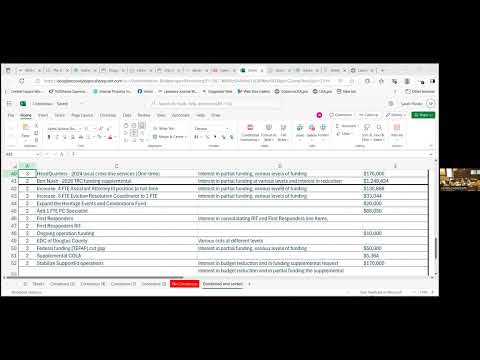
Douglas County sets aside $1 million for crisis system operations, $500,000 for Bert Nash solvency and $300,000 for local crisis line review
Summary
At a July 15 work session the Douglas County commissioners agreed to reserve $1 million in ongoing behavioral-health sales tax funds for crisis-system operations starting in 2026, to hold $500,000 one-time for solvency and operational review of Bert Nash, and to set aside $300,000 one-time for Headquarters (the local crisis line) solvency review;
The Douglas County Board of County Commissioners on July 15 agreed to reserve money to stabilize the county's crisis response system while staff and partners complete financial reviews of local providers.
The commission directed staff to set aside $1 million in ongoing behavioral-health sales tax funding for crisis-system operations beginning in 2026, and to hold $500,000 in one-time funds for solvency work and an operational review related to Bert Nash Health Center. Commissioners also agreed to set aside $300,000 in one-time funds to support a solvency conversation for Headquarters, the local crisis phone line, rather than approving retroactive payments for 2024 and 2025.
Why this matters: Commissioners said they want to avoid committing ongoing taxpayer dollars until outside reviews and audits clarify providers' financial status and the state funding picture. Bert Nash runs the county's crisis receiving center (TRC) under a contract that currently runs through 2026; county staff and commissioners said they need up-to-date audits, a clearer KDADS (state) funding picture, and an operational review before signing or expanding multi-year agreements.
Most important facts: County staff told commissioners that Bert Nash now receives about $3.1 million directly from KDADS to operate the TRC and that the TRC represents roughly 25% of Bert Nash's operations. Commissioners expressed concern about rising TRC costs, staff safety, and fiscal uncertainty in recent budgets. The board asked staff to convene a meeting with Bert Nash leadership and the county's behavioral-health oversight group as soon as practicable to review financial statements and audits, and to request KDADS clarify the 2026 contract status.
Details and conditions: Commissioners repeatedly rejected retroactive funding for services rendered without an executed county contract. Staff recommended paying a 2023 invoice only after the county reviews the associated contract and creates an audit trail; staff said it will bring that prior-year payment back to the commission for formal approval. The commissioners also tied any 2026 funding for Bert Nash to completion of an outside operational review of the TRC and to KDADS' confirmation of state obligations.
Commissioner positions and next steps: No formal vote was taken in the work session, but commissioners indicated informal consensus on the set-asides and on requiring additional financial review. Staff will: (1) place the 2023 invoice back on a future agenda for formal payment after audit review, (2) arrange a financial review meeting with Bert Nash leadership and the county dashboard/oversight team, (3) pursue an operational review of the TRC (costs to be determined), and (4) bring recommendations and contract language to the commission before executing any 2026 operating agreement.
Context and limitations: Commissioners noted that Headquarters operates as a state-funded partner for answering 988 calls and that other counties rarely fund a local crisis line directly. Several commissioners said they would prefer the state to fund local crisis-line operations but recognized the county may need to act temporarily to maintain services. Staff emphasized that decisions about ongoing obligations will depend on completed audits, KDADS determinations and evidence that nonprofit boards have reconstituted governing bodies where applicable.
What happens next: Staff will present the audit outcomes and the operational-review recommendations to the board before executing 2026 contracts. Commissioners signaled they will consider one-time solvency funding proposals from provider boards and expect those partners to show matching commitments.