Get Full Government Meeting Transcripts, Videos, & Alerts Forever!
Get email alerts on the Behavioral Health Funding topic
No spam. Unsubscribe anytime.
Commissioners allocate and flag behavioral-health items: HUD replacement, 0Suicide coordinator and expanded substance-use treatment
Summary
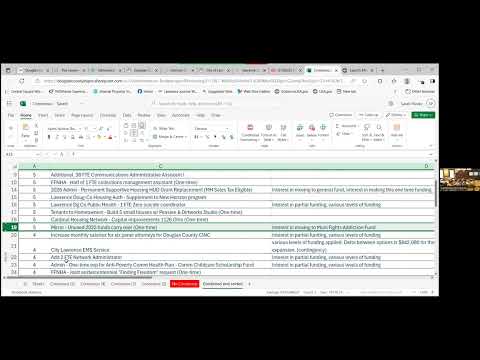
During budget deliberations commissioners tentatively funded several behavioral-health items and flagged others for future review, including the permanent supportive housing HUD replacement request, a 0Suicide coordinator funding split (ongoing vs. one-time), and a request to expand Mirror substance-use services.
Douglas County commissioners reviewed multiple behavioral-health budget requests on Tuesday and reached tentative positions on a set of items while flagging others for follow-up.
On permanent supportive housing and a HUD grant replacement, commissioners discussed options to fund ongoing operating costs from the behavioral health sales tax fund, the general fund, or as one-time dollars while pursuing federal HUD support. Commissioners repeatedly described the HUD replacement as a service-area need that may require federal help as well; staff provided two figures: an ongoing cost of $321,032 and a one-time carryover of $171,512. Commissioners asked staff to highlight the item for future follow-up and confirmed it would remain funded for now but revisited in later budget sessions.
Commissioners also discussed the 0Suicide coordinator request. Staff told the group that the total ongoing need previously presented was $43,000, and that, after prior conversations, $27,050 had been shown as ongoing with a $15,050 one-time delta for catch-up. Commissioners heard that grant funding had not been secured for the additional $15,050 and agreed that one-time funding was permissible if the commission wished to cover the catch-up amount; several commissioners included the $43,000 ongoing figure in their marks while some supported splitting the difference with a one-time catch-up.
Separately, the Mirror program asked for additional substance-use treatment funding. Commissioners debated whether to pay for the $79,000 increase from the behavioral health fund or from the smaller municipalities-fights-addiction fund (special alcohol/municipal fund). Staff warned that the latter has roughly $445,000 available but much lower annual inflows and that recurring use could deplete that smaller fund quickly. The majority favored using the behavioral health sales tax fund for the Mirror request and added it into the package.
Where commissioners could not agree on ongoing funding commitments, they often directed staff to program one-time funding this year and return with options for sustainable funding in 2027. Several members also asked staff to produce clearer worksheets showing where items had already been included in the proposed budget and where they were new additions.
No formal roll-call votes were recorded on these items during the session; commissioners reached working consensus on funding placement and scheduled follow-up work for the items before final budget adoption.