Get Full Government Meeting Transcripts, Videos, & Alerts Forever!
Get email alerts on the Arts Grants topic
No spam. Unsubscribe anytime.
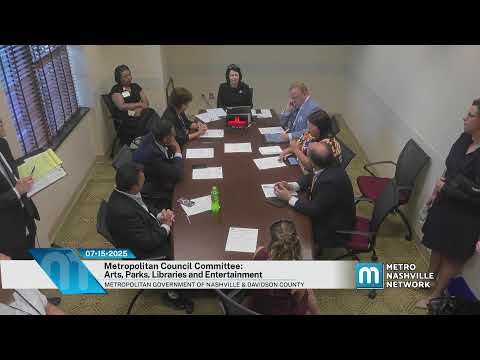
Arts, Parks, Libraries & Entertainment Committee approves Metro Arts grant criteria despite public opposition
Summary
The committee approved Resolution RS2025-13555 setting criteria for Metro Arts operating support and Thrive grants for fiscal 2026. The vote follows public praise for the commission and a public commenter who said the changes would defund artists in South Nashville.
The Arts, Parks, Libraries & Entertainment Committee on Tuesday, July 15, 2025, approved Resolution RS2025-13555 establishing criteria for operating support and Thrive grants for fiscal 2026 for the Metropolitan Nashville Arts Commission.
The resolution matters because it changes how Metro Arts will award project grants: the maximum request for Thrive grants is lowered from $20,000 in prior cycles to $15,000, the prior practice of scaling award amounts (for example, awarding a percentage of the requested amount) will not be used, and the committee was told the fiscal sponsor fee will no longer be deducted from artist budgets.
Lydia Youssef, one of the Title VI complainants from fiscal year 2024, urged the committee to reject the criteria, saying the change is “inequitable” and will “defund South Nashville.” She said cutting the Thrive cap to $15,000 disproportionately harms working-class artists and local muralists and criticized the fiscal sponsorship requirement for local artists. “Cutting Thrive to $15,000 is inequitable,” Youssef said.
Campbell West, chair of the Metropolitan Nashville Arts Commission, addressed the committee before the vote and thanked members for their support of the commission. Ashley Batchelder, interim director of Metro Arts, explained the technical changes: the maximum request amount this year will be $15,000 and grants will be project-based, so applicants requesting any amount up to $15,000 would either receive that full requested amount or not be approved; the previous practice of scaling request amounts will not be used this year. Batchelder said, “the last 2 years, the applications had a maximum request amount of $20,000 ... and then what happened the last 2 years is that that was scaled to what the award amount would be,” and that scaling will not occur in this cycle.
Batchelder also said the fiscal sponsor fee—previously allowable up to 10% of artist budgets and sometimes taken out of the artist allocation—“will not be coming out of the budget,” keeping more funding directed to projects. She described the larger allocation conversation as “holistic,” noting that in the current cycle the allocation was 60% to operating and 40% to Thrive and that final allocation decisions will follow the application period and a review of submissions.
Council member Welsh said the committee should approve the resolution to “get back on track,” saying approval would allow applications to open the next day and funds to reach the community by November. Vice Chair Voe asked for clarification about the change from $20,000 to $15,000 and whether applicants could request smaller amounts; Batchelder confirmed applicants can request any amount up to the $15,000 cap and that a requested $5,000 project would receive $5,000 if approved.
A motion to approve the resolution was moved and seconded; the committee voice-voted and the resolution passed as recommended, with some members indicating “present, not voting.” The committee recorded no roll-call tally in the transcript.
Next steps described in the meeting: Metro Arts will open applications the day after the meeting and will finalize allocation percentages after reviewing applications in September. The interim director said staff will work on longer-term criterion changes later in the year to address remaining concerns voiced by committee members and the public.