Get email alerts on the Mixed Use Districts topic
No spam. Unsubscribe anytime.
Planner briefs St. Cloud commission on mixed-use districts, county growth strategy
Summary
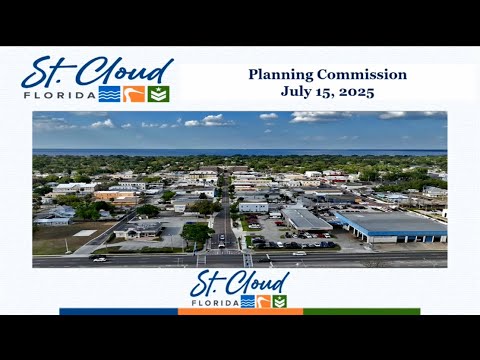
John F. Adams, vice president of RJ Witten & Associates, gave a training to the St. Cloud Planning Commission on the history, purpose and design principles of mixed-use districts and how those districts fit into Osceola County's urban growth strategy.
John F. Adams, vice president of RJ Witten & Associates, gave a training to the St. Cloud Planning Commission on the history, purpose and design principles of mixed-use districts and how those districts fit into Osceola County's urban growth strategy.
The presentation reviewed the county's shift from low-density suburban development to defined urban growth areas and mixed-use centers, the role of conceptual master plans and site development plans, and how infrastructure and phasing are intended to support new residential and nonresidential growth. "If we kept doing what we were doing, their taxes are going up," Adams said, summarizing a central rationale for higher target densities in mixed-use districts.
The training opened with Melissa Dunklin, the city's director of community development, noting the meeting's training purpose and that a zoning map amendment advertised for the meeting (ZMA 25-000005, ordinance no. 2025-59) had been postponed to the next month because it must follow updates to the future land use element. "Yes, tonight is a training session," Dunklin said at the outset.
Why it matters
Adams traced the policy evolution that led the county to adopt an urban growth boundary and mixed-use district regulations: state growth-projection requirements, regional reviews of large developments, an Urban Land Institute study, and subsequent county policy choices to concentrate growth in centers rather than linear strip commercial corridors. Adams cited the conceptual master plans for multiple mixed-use districts and said the combined county approvals total 116,564 dwelling units and 40,000,000 square feet of nonresidential support as a growth-management strategy.
Key points from the presentation
- Purpose and scale: Adams said the county's policy seeks a long-term average density target (countywide math that aims to average roughly three dwelling units per acre overall) so the tax base can support infrastructure and services. He described a range of place types required by the code (Neighborhood 1 and 2, neighborhood/community/urban centers, open space, and special districts) and the minimum land-use mixes associated with each place type.
- Plan hierarchy and approvals: Adams explained that conceptual master plans establish place types, densities (single-family detached vs. multifamily/attached), open-space systems and major road corridors; subsequent preliminary subdivision and site development/engineering plans provide the detailed lotting, building types and utility designs required before construction.
- Design and connectivity: The training advocated interconnected street networks, buildings oriented to the street with parking to the rear, pedestrian amenities (street trees, sidewalks, trails) and planning for future transit. Adams showed the Edgewater conceptual master plan as an example, including roadway frameworks, walkable radii around centers and a phasing illustration tied to a future turnpike interchange.
- Flexibility and economic development: Adams described special-district provisions for uses that do not fit the standard mixed-use form (industrial, distribution, medical complexes) and warned against rigid rules that could push employers to other jurisdictions.
Questions and local concerns
Commissioners asked several questions about connectivity across the Turnpike, timing of key road projects, public safety and water resources. Adams said the Turnpike and large bridge crossings are costly and require regional funding, and he noted the County's Southeast Area Transportation Study (SEATS) and a planned new turnpike exchange (cited in the presentation as expected in 2028) as elements intended to relieve future traffic. On water, Adams explained that St. Cloud lies within the South Florida Water Management District's regulatory area and characterized water-quality regulation and permitting as a constraint the county must address.
Staff direction and next steps
Dunklin told the commission that staff will bring an updated future land use element to the commission next month that incorporates many of the policies discussed in the training. At the meeting's close the commission moved to adjourn; the motion was seconded and the chair called the question.
Votes at a glance
- Motion to adjourn the meeting: moved (speaker not specified), seconded (speaker not specified); outcome: approved (voice vote recorded as "Aye").
Ending
Commissioners and staff indicated interest in a follow-up session focused on the design standards and implementation details. Dunklin said the city will circulate the comprehensive-plan material in advance of next month's meeting so commissioners have more time to review the future land use element update.
AI generated
The text on this page is AI generated. Summaries, highlights, analysis, and video transcripts are all produced from the original source material.
AI can make mistakes, so if you spot one, and we will fix it for everyone.
Note: the source content is unaltered by us. Any content source we link to, be it a video, an audio recording, or a document, is presented exactly as its publisher released it. That publisher is usually a government body, sometimes an individual official or another organisation.