Get Full Government Meeting Transcripts, Videos, & Alerts Forever!
Get email alerts on the Franchise Fees topic
No spam. Unsubscribe anytime.
Council holds public hearing on utility franchise fees, opts to delay any rate increase
Summary
After a public hearing and extensive council discussion, Bloomington voted July 14 to make no changes to CenterPoint and Xcel franchise fees for 2026 and directed staff to return in spring 2026 for further consideration.
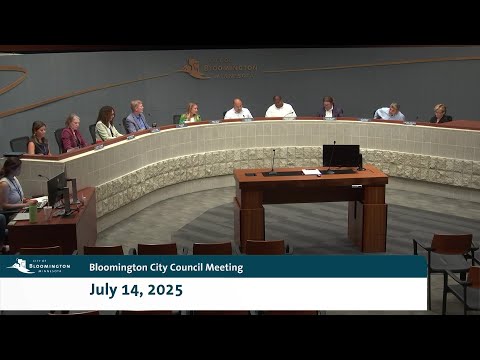
Bloomington council members on July 14 held a public hearing on proposed changes to Chapter 20 franchise fees for CenterPoint Energy and Xcel Energy and then voted to hold rates at current levels for 2026.
Why it matters: The franchise fee is a monthly line item on utility bills that the city has used since 2016 to fund street and trail pavement management and related capital work. Staff presented three options: no change, a modest increase to fund retaining-wall work, or a larger increase to fund retaining walls plus a sustainability loan/grant program for home energy upgrades.
City engineer Julie Long and senior civil engineer Bob Simons led the technical presentation and CFO Laurie Economy Schroeder discussed the revenue options. Schroeder explained three staff options: (1) add $0.23 per utility account per month (about $200,000 per year) dedicated to retaining-wall work; (2) add $0.70 per utility plus $0.23 to yield roughly $1,000,000 for sustainability plus $200,000 for retaining walls (total $0.93 increase); or (3) no change and remain at $5.95 per month. Simons described planned trail and sidewalk work on Normandale Boulevard and Old Shakopee Road and noted retaining-wall projects that can cost from about $250,000 to over $1 million depending on scope.
Resident Mark Hemmer spoke during the public hearing and expressed opposition to using franchise fees as a recurring revenue source, saying the charge has become “a huge amount” on some customers and arguing the city should consider the property-tax levy rather than continued fee increases. Hemmer also noted state law and Public Utilities Commission practice allow utilities to pass such fees through to customers.
Council discussion covered equity and policy considerations. Several council members said they were sympathetic to the retaining-wall needs but questioned whether a fee tied to utilities is the appropriate funding vehicle for sustainability programs targeted at home energy improvements. Council member D’Alessandro asked whether the city could pursue state-level or legislative remedies to change how fees are applied; the mayor suggested adding legislative action to the 2026 priorities list.
Council action (formal): Two motions were made—one for CenterPoint Energy franchise fees and one for Xcel Energy franchise fees—both to make no increase for 2026, and to direct staff to return in spring 2026 to consider future fee changes. Both motions passed 7–0.
Discussion vs. decision: The hearing included a mix of public comment, staff explanation and council debate about options and trade-offs; the formal decision was to delay any increase and return with additional work in spring 2026. Staff told the council that state law and the PUC create limits on how utilities handle franchise fees and that utilities typically pass franchise fees through to customers as allowed by regulators.
What’s next: Staff will return in spring 2026 with additional analysis. Council members discussed asking the city’s state legislative advocates to pursue statutory or regulatory change to broaden how utilities and other right-of-way users are charged.
Sources: City staff presentation, public comments at Bloomington City Council meeting, July 14, 2025; speakers Julie Long, Bob Simons, Laurie Economy Schroeder, resident Mark Hemmer.