Get Full Government Meeting Transcripts, Videos, & Alerts Forever!
Get email alerts on the Facilities topic
No spam. Unsubscribe anytime.
Goshen schools outline multi‑year facilities work, weigh short‑term fixes as enrollment rises
Summary
District staff reviewed year‑2 capital projects — HVAC control replacements, roofing, blacktop and stadium lighting — and SHP consultants presented a master‑planning assessment that flagged limited small‑group and intervention spaces and recommended short‑term re‑use and community engagement before any ballot measure.
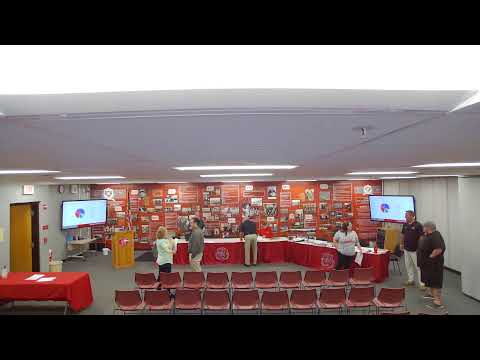
Troy Smith, speaking to the Goshen Local Board of Education on June 9, presented the district’s year‑2 capital facilities update and a roster of planned and in‑progress campus projects, while a separate master‑planning presentation from SHP outlined capacity constraints and short‑ and long‑term options.
The update outlined ongoing replacement of HVAC controllers and servers across campus, roofing repairs and infrared scans, blacktop milling and repaving, stadium LED lighting and perimeter security upgrades, playground replacement at Mark Cook, pond drainage work and signage and a new crosswalk on Linton Road. “So, basically, in a nutshell, this is taking out all of the controllers in every single room, this room included, that are the touch points for our software to read,” Smith said of the HVAC control project.
The district’s facilities manager said Spalding was the first building to receive new controllers and servers, the high school and middle school work is underway, and the plan calls for a year‑3 software cutover that would allow campus‑level HVAC control rather than separate, room‑level touchpoints. Smith also said the district contracted Garland to add snow rails to the high‑school roof after winter damage and that infrared scans are being used to prioritize roof repairs.
Charlie, a consultant from SHP contracted for the district master‑planning process, presented a spring 2024 “snapshot” assessment of building use and capacity. “Intervention and small‑group spaces are challenged at your current buildings,” Charlie said, noting many intervention rooms are in closets or windowless spaces. SHP’s analysis flagged libraries, stages and locker corridors as areas that could be reprogrammed to create additional small‑group or intervention spaces.
District staff and SHP emphasized the combined approach: pursue smaller, lower‑cost changes on campus as short‑term “swing‑space” solutions while completing community engagement and cost estimates for longer‑term options. Administrators described potential short‑term moves such as repurposing the current board office footprint at Mark Cook into approximately five classrooms and adding modular units where necessary. At the same time they cautioned that add‑ons often trigger larger code and infrastructure upgrades (for example, fire alarms, ductwork or electrical capacity) that can substantially raise costs.
Board members and staff discussed costs and timing: modular classroom leases were described in the meeting as “about $800” (monthly, per transcript), while board members and SHP gave a ballpark for building a new standalone board office at roughly $4–5 million. One SHP representative noted that using existing interior square footage is typically far more cost‑effective than new construction: “You have utilized your existing square footage is the most cost effective way of doing it,” he said.
Administrators also laid out near‑term campus work that will be completed over the summer: partial milling and repaving at Spalding, curtain/drain repairs at the track to address chronic water saturation, replacement of auxiliary bleachers and end mats, replacement of 32 of ~111 outdoor light fixtures to bring the fleet under warranty, and procurement of a new playground structure slated for mid‑July installation. Smith said the district’s maintenance team completes much of this work in‑house.
SHP and district leaders warned that continuing residential development in the district footprint — several subdivisions and hundreds of housing permits were listed by staff during the presentation — will increase enrollment pressure. Administrators said several developments are under way or permitted and that staff have tallied houses under construction and plans (examples named in the meeting included Barklagger, Lakefield, Villages of Belmont and Pebble Grove). The consultants said Spalding is currently the most heavily used elementary building and would be the first to feel additional growth pressure; Mark Cook was identified as the campus with the most opportunity to reconfigure internal space to relieve crowding.
The board was given a timeline for community engagement: a fall survey on facilities, followed by meetings and public sessions in September–November to build a short‑term plan and a long‑range vision. Staff recommended against taking a bond or levy to the ballot in the immediate term, saying the district should complete community engagement and cost‑estimates first. “I do not think, and I think conversations with you guys, a return to the ballot right now is not recommended at this time,” one administrator said.
Why it matters: the district is balancing everyday maintenance and safety needs (roofs, HVAC, lighting) with constrained capital resources amid rapid local housing growth and rising student numbers. Staff urged the board to decide which short‑term reassignments are acceptable to the community before pursuing larger, more expensive construction that could require a ballot measure.
The board took no formal action on long‑range planning during the meeting; trustees asked staff to continue gathering cost estimates and to begin the planned fall community engagement.
Administratively, the board will receive SHP’s continued work product in the coming months and consider short‑term recommendations that could be implemented without a new bond or levy.