Get Full Government Meeting Transcripts, Videos, & Alerts Forever!
Get email alerts on the Juvenile Detention Education topic
No spam. Unsubscribe anytime.
Rutherford County board hears juvenile detention education report, asks staff to quantify funding options for Penn Foster
Summary
Officials heard a detailed report on education and rehabilitation work at the Rutherford County Juvenile Detention Center, learned the facility holds 10 youths (seven from Rutherford County), and asked staff to return with cost and impact data — including potential funding to expand Penn Foster access for detained youth.
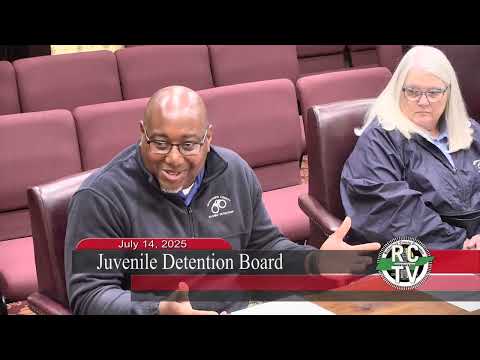
Mayor Joe Carr and other county officials on the board spent more than an hour Wednesday reviewing educational and rehabilitative services at the Rutherford County Juvenile Detention Center, where staff said 10 young people are detained and that limited time and funding constrain efforts to keep youth on track academically.
The presentation by Garland Henley, who identified himself as a Transits Life Skills facilitator at the detention center, explained staff composition, programming and the center’s emphasis on mentorship and short-term interventions to build “self-control, leadership, maturity and hope.” Miss Duke, a detention-center staff member, told the board: “There are 10 young people in our facility, 7 of those from Rutherford County, 1 each from Gibson, Lauderdale, and Montgomery.”
Henley framed the center as a corrective environment designed to stabilize youth briefly so they can resume schooling or earn credits. “The Rutherford County Juvenile Detention Center, how I see it is that it’s a greenhouse,” Henley said, describing rules and routines as structure intended to help youths establish the “roots” they need after release. He and staff described a mix of paid employees and volunteers who provide classes, trade exposure, counseling and faith-based support.
Board members pressed staff on concrete resources that could expand educational outcomes. Henley and others described existing offerings: one full-time teacher, Michael Vaughn (a Rutherford County Schools employee), an educational assistant (part-time), a part-time chaplain called “Pastor T,” volunteer-based guest speakers and periodic behavioral-health sessions. Henley said the center has a 10-day intake window to obtain records and place students in appropriate courses and that they perform educational assessments for each newcomer.
A recurring topic was Penn Foster, an online diploma/credit-recovery program currently used by some detained students. Henley estimated Penn Foster enrollment costs at roughly $1,200–$1,400 for the full program, with a multi-year payment plan available; he said two youths were currently enrolled and that another four to five detained youths could benefit if funding were provided. Mayor Joe Carr summarized the board’s question: “If Penn Foster is that start place ... if we could have some financial resources to provide Penn Foster to our kids, that might be a turning point.”
Members raised competing priorities and practical questions: several asked whether the county should subsidize individual educational accounts for detained youth while victims of crimes receive no equivalent direct restitution. Others said the issue could be framed as an investment in reducing recidivism. Several board members suggested grants, nonprofit partnerships or state assistance could supplement county funding rather than relying solely on local dollars.
Board members asked Henley, Captain Cesar and Miss Duke to return with financial estimates and data that would let the board evaluate how county funds, grants or partner organizations could expand access to Penn Foster or similar options. The board did not adopt any new county funding at the meeting; members described the next step as staff-provided quantification and exploration of grant and nonprofit options to present at a future meeting.
The meeting also recorded a brief formal action to approve the previous meeting minutes. Judge Steve Daniel moved to accept the minutes; Dr. Anita Herring seconded the motion, and the board voiced approval.
The board’s discussion emphasized two recurring themes: (1) the detention center’s reliance on staff and volunteers to provide mentorship and exposure to jobs/trades, and (2) the difficulty of delivering sustained academic progress to a transient population with widely varying legal timelines. Officials said more study, budget figures and possible grant partners are needed before the board will consider a formal funding decision.