Get Full Government Meeting Transcripts, Videos, & Alerts Forever!
Get email alerts on the Redevelopment Tif Financing topic
No spam. Unsubscribe anytime.
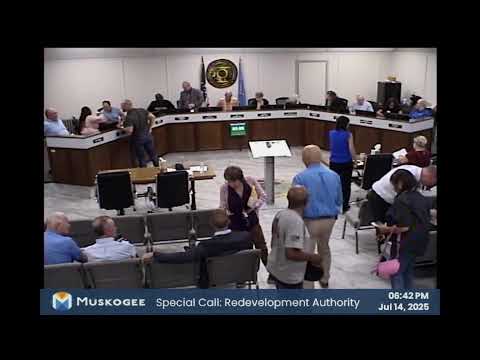
Muskogee approves URA tax-increment note to fund retail infrastructure, initial draw $1.095M
Summary
The City of Muskogee and its Redevelopment Authority approved a resolution July 14 authorizing issuance of a tax increment revenue note (Taxable Series 2025) to fund URA infrastructure, with an initial draw of $1,095,000.
The City of Muskogee on July 14 approved a resolution authorizing the Muskogee Redevelopment Authority to issue a tax increment revenue note, taxable series 2025, to finance projects in the Muskogee Urban Renewal Area (URA). Staff and outside counsel described the financing as a drawdown loan that will let the authority access remaining authorized TIF funds to support ongoing infrastructure construction for a new retail development.
Nathan Ellis of Public Law Finance Group told council the initial draw will be $1,095,000; those proceeds will cover costs of issuance and set-aside dollars that, together with previously collected TIF revenues, will be sufficient to make a $1.5 million incentive payment under a related development agreement. Ellis said the note will be variable-rate, initially 7.25%, tied to the prime rate, and will mature no later than July 1, 2033. Bank First is the lender; the firm is the lead in a consortium of local banks that will fund the note.
Tara Shows (city staff) said approval by the council is required because the URA is a public trust that issues debt; the companion URA resolution passed at a Redevelopment Authority meeting the same evening. The resolution included a waiver of competitive bidding for the negotiated sale, a common practice for revenue notes when a specific local lender is participating.
Council members asked for clarification on how the TIF collects revenue. Ellis described the TIF split: the district collects 75% of new ad valorem and 75% of incremental sales tax generated above historical baselines; the remaining 25% of new revenues are distributed to taxing entities. City staff recommended approval; both the city council and the Redevelopment Authority approved their respective resolutions (council vote passed with a supermajority; one councilor voted no on the Redevelopment Authority vote as recorded).
Why it matters: The financing unlocks TIF dollars already authorized in the URA plan and provides immediate cash to support infrastructure tied to a retail project. The transaction layers new debt on prior URA financing (a 2014 note) and includes a foundation guarantee and parity provisions to secure the obligations.