Get Full Government Meeting Transcripts, Videos, & Alerts Forever!
Get email alerts on the Student Loan Repayment topic
No spam. Unsubscribe anytime.
California previews Medi‑Cal behavioral health loan‑repayment program; applications open July 1
Summary
The Department of Health Care Access and Information and the Department of Health Care Services previewed a new Medi‑Cal Behavioral Health Student Loan Repayment Program under the BH Connect waiver, saying the program will use federal Section 1115 authority to reduce student debt and recruit behavioral‑health practitioners to Medi‑Cal safety‑net settings; the application opens July 1 and is due Aug. 15.
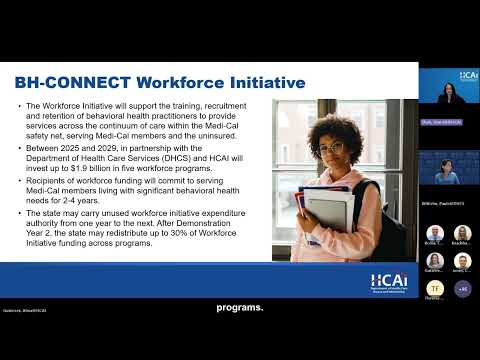
The Department of Health Care Access and Information (HCAI), in partnership with the California Department of Health Care Services (DHCS), on an informational webinar detailed a new Medi‑Cal Behavioral Health Student Loan Repayment Program that is part of the broader BH Connect initiative and will use Section 1115 demonstration authority to expand the state’s behavioral‑health workforce.
Dr. Sharmila Shah, behavioral health and policy branch chief for health workforce development at HCAI, said the program is intended to “support and retain behavioral health providers, particularly in underserved and high‑need communities, by helping to reduce the burden of student loan debt.” The agencies said the BH Connect waiver and related state plan amendments were approved by the Centers for Medicare & Medicaid Services (CMS).
Why it matters: California faces a statewide behavioral‑health workforce shortage, officials said, and the program is designed to steer more clinicians into Medi‑Cal safety‑net settings by tying loan‑repayment awards to future service commitments.
Program size and timeline: HCAI and DHCS described BH Connect’s workforce initiative budget as up to $1.9 billion between 2025 and 2029 for five programs; for this loan‑repayment cycle the agencies said up to $90 million is available. The application opens July 1, the application deadline is Aug. 15, award notices are expected in November and grant agreements are planned to start in December. Officials said awards will be paid directly to loan servicers and that the program will not pay recipients directly.
Who can apply: Policy analyst Christian Jones (HCAI) summarized eligible professions in three broad tiers. Licensed prescribing behavioral‑health practitioners eligible for the top tier (up to $240,000) include psychiatrists, psychiatric mental health nurse practitioners and addiction medicine physicians. Licensed non‑prescribing or associate‑level clinicians (up to $180,000) include clinical social workers, licensed clinical psychologists, marriage and family therapists, professional clinical counselors and certain psychiatric technicians and occupational therapists. Non‑licensed or non‑prescribing practitioners (up to $120,000) include alcohol and other drug counselors, certified peer support specialists, community health workers and registered nurses working in qualified behavioral‑health settings. Jones noted some practitioner types may be added if they meet Medi‑Cal provider qualifications under specialty mental health, Drug Medi‑Cal or Drug Medi‑Cal organized‑delivery‑system rules.
Service commitments and limits: For licensed prescribing and licensed non‑prescribing (including associate/pre‑licensure) categories, the agencies said any award triggers a four‑year service obligation. “If you get $1 of loan repayment, it is still a four‑year service obligation,” Jones said. For the non‑licensed category, service obligations vary by award amount: $200,000 or more = four years; $10,000–$20,000 = three years; less than $10,000 = two years. All service obligations must be served full time (definition to be finalized in the grant guide) and must be completed by Dec. 31, 2033, a limit the agencies said stems from the federal special terms and conditions (STC).
Where service can be served: The STC requires service in a Medi‑Cal safety‑net setting. HCAI and DHCS listed explicit qualifying sites such as federally qualified health centers (FQHCs), community mental health centers and rural health clinics. The STC also allows other behavioral‑health settings that meet a payer‑mix test: hospitals with 40% or greater Medicaid/uninsured payer mix, rural hospitals with 30% or greater Medicaid/uninsured, or other settings with 40% or higher Medicaid/uninsured. Officials said the agencies will publish a grant guide and further site guidance at launch; they warned that many site determinations will be made during eligibility review rather than before application.
Eligibility questions and common scenarios: DHCS Deputy Director Paula Wilhelm and HCAI staff addressed frequent queries: applied behavior analysis (ABA) practitioner types are not eligible because ABA is not classified as a specialty behavioral‑health benefit in Medi‑Cal; community health workers and licensed vocational nurses may qualify if they meet provider‑type and site requirements; private‑practice clinicians may qualify if they meet the payer‑mix and contracting criteria; and some school‑based roles and certain county/state employee situations require case‑by‑case clarification. The agencies repeatedly said incomplete or ambiguous cases will be clarified in July materials or during eligibility checks after application.
Interactions with other loan programs and payments: Officials cautioned applicants to consider other federal programs such as Public Service Loan Forgiveness (PSLF) when choosing whether to apply, noting the programs operate independently and that existing service obligations tied to other awards can create conflicts. The agencies reiterated awards will be disbursed to loan servicers and that repayment will not be retroactive for past service. Officials said they are finalizing operational details about coordination with loan servicers, payment timing during service, and documented leave policies for service obligations.
Selection and prioritization: HCAI and DHCS said they will run a single application cycle, conduct eligibility checks and score applicants under criteria to be published in the grant guide. If demand exceeds available funding, officials said they will use scoring and targeted preferencing (for example by geography or provider type shortages) to prioritize awards; if undersubscribed, eligible applicants could receive awards without preferencing.
Questions and next steps: The agencies urged interested applicants to review the grant guide when it posts with the application on July 1, to attend a follow‑up early‑July webinar for more operational detail, and to direct questions to mbhslrp@hcai.ca.gov. HCAI recommended subscribing to its health‑workforce mailing list and said webinar materials and a recording will be posted to the HCAI website within 7–10 business days.
The presentation repeatedly emphasized that final eligibility, award decisions and operational rules are governed by the BH Connect STC with CMS and the program’s forthcoming grant guide, which will provide the definitive definitions for full‑time service, eligible site lists and scoring criteria.