Get Full Government Meeting Transcripts, Videos, & Alerts Forever!
Get email alerts on the Property Taxation topic
No spam. Unsubscribe anytime.
Whitfield County reassessment draws public outcry; assessors cite state rules
Summary
At the July 14 Whitfield County Board of Commissioners meeting residents sharply criticized the Board of Tax Assessors' amended 2024 reassessment and its effect on homeowners and small businesses; a Board of Assessors member defended the methodology and cited Georgia law and Department of Revenue standards.
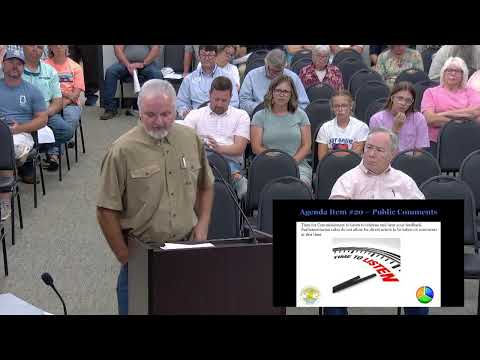
At the July 14 Whitfield County Board of Commissioners meeting, former Dalton mayor David Pennington and several residents urged the county to reconsider an amended 2024 property digest that they said shifts large tax burdens onto homeowners and small local businesses. "This will be when you add the 2 together, by far, the largest tax increase mostly falling on homeowners and small local businesses in this county's history," David Pennington said during public comment. Board of Assessors member John Maynor defended the reassessment and described the office's use of the statutory mass-appraisal process under Title 48 and Georgia Department of Revenue guidance. Maynor cited the digest's statistical measures and argued the amended 2024 digest moved the county into an acceptable sales-ratio range. "This current board of assessors has presented a board that is uniform and is accurate within the methodology that's prescribed to us by the Department of Revenue," Maynor said, and asked elected officials to "stop interfering with the work of the Board of Assessors." Why it matters: speakers said reassessment outcomes could create immediate tax-bill increases for homeowners and businesses, trigger a surge in appeals and impose recurring costs on school funding and state reimbursements. Maynor gave examples of impacts and numbers he said were in the assessor materials: a roughly 43% average increase in assessed values for residential parcels, a 2024 amended digest sales-ratio reported at 39.48 percent, a statutory fine of $5 per parcel if a digest remains out of tolerance, and an estimated annual loss to state QBE school funding of roughly $5 million to $10 million tied to an undervalued digest. He also said appeals costs could push the assessor's budget up by about $100,000. During public comment, residents described specific examples they said showed uneven assessments, asked whether assessors inspect properties in person, and urged more transparency and communication from the Board of Assessors and the commissioners. Kathy Holmes urged the commissioners to ensure the assessor's office can recruit and pay for a highly qualified lead assessor. Commissioners did not vote on the reassessment at the meeting. Commissioners said they were available to assist the Board of Assessors on recruitment and communication; the county administrator said the commissioners would support an external, nationwide search if the assessor's office requests it. No formal change to millage or county action on the digest was taken at the July 14 meeting. Ending: Several speakers warned of practical consequences if taxes rise sharply, including unaffordability for renters and homeowners; commissioners and staff said they would continue to review the assessor materials, meet with the Board of Assessors as needed and that the appeal process remains available to taxpayers.