Get Full Government Meeting Transcripts, Videos, & Alerts Forever!
Get email alerts on the Potholes Maintenance topic
No spam. Unsubscribe anytime.
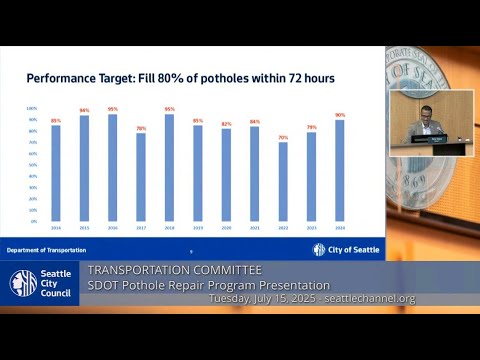
SDOT: Seattle crews filled 90% of reported potholes within 72 hours in 2024; department outlines limits and longer-term work
Summary
SDOT briefed the transportation committee on the city’s pothole repair program, describing a largely reactive first-response patching process, annual volumes of 15,000–25,000 potholes, a 72‑hour response goal (80% target), and larger capital paving programs funded by the 2024 transportation levy to address long-term pavement needs.
Seattle Department of Transportation officials briefed the City Council Transportation Committee on July 15 on how the city responds to potholes, the limits of short-term repairs and the larger investments intended to reduce recurring pavement failures.
SDOT pavement engineering manager Elsa Tibbetts explained the agency treats pothole repair as a short-term “band aid” to keep streets serviceable while arterial major maintenance (AMM) or full reconstruction restore pavement life. Tibbetts said, “A pothole is an abrupt depression in the roadway, typically where traffic loading has broken loose a section of pavement,” and noted potholes most frequently appear after precipitation and freeze-thaw cycles that weaken pavement layers.
Key figures SDOT presented: - Seattle has approximately 1,153 arterial lane miles to maintain. - SDOT typically fills 15,000 to 25,000 potholes per year; in a severe winter year the tally can be much higher (the agency repaired over 35,000 potholes in 2017). - SDOT’s operational goal tied to the 2024 transportation levy is to repair 80% of reported potholes within 72 hours; the department reported meeting a 90% completion rate in 2024. - SDOT reported an arterial rehabilitation backlog of roughly $460 million (covering about 312 lane miles) and an additional reconstruction need of about $1.4 billion across 286 lane miles. - The arterial asphalt and concrete (AAC) program under the 2024 transportation levy is funded at $330 million over eight years (about $41.25 million annually), an increase from the prior levy level.
Tibbetts described SDOT’s multi-tiered response: immediate pothole crews use a first-reported, first-repaired prioritization; AMM crews provide stitches that extend pavement life by two to five years; AAC/full reconstruction restores the subgrade and is treated as a longer-term “surgery” for severely damaged streets. SDOT maintains four hotbox trucks positioned around the city and a maintenance workforce the agency described by job roles (crew chiefs, drivers, rakers, asphalt crews).
Committee members praised the crews’ performance but pressed SDOT for clearer public communication about reporting outcomes. Council member Strauss said residents sometimes receive closed Find It, Fix It tickets for locations that still show significant surface damage; SDOT responded that the agency is working to improve Find It, Fix It notifications so crews can post a photo showing a repair and automatically notify the reporting resident. SDOT also noted that some larger “spot repairs” or AMM work require feasibility analyses, traffic counts, utility coordination and concurrent capital work, which lengthens delivery timelines.
Public comment earlier in the hearing included a call for more bus lanes to improve transit reliability — testimony SDOT and committee members referenced while discussing corridor-level investments such as Denny Way and Route 8. Committee Chair Rob Sacca and Council members urged continued investment in both maintenance crews and larger capital paving programs, and encouraged council members to schedule site visits with SDOT maintenance crews to see work firsthand.
SDOT told the committee the agency will continue winter surge patrols, pre-season proactive repairs, and coordination with utilities and other departments as part of a layered strategy that combines reactive pothole patches with AMM and AAC investments to reduce repeat failures.