Get Full Government Meeting Transcripts, Videos, & Alerts Forever!
Get email alerts on the Student Outcomes Monitoring topic
No spam. Unsubscribe anytime.
OKCPS board holds training to make monthly goal monitoring central to student-outcomes oversight
Summary
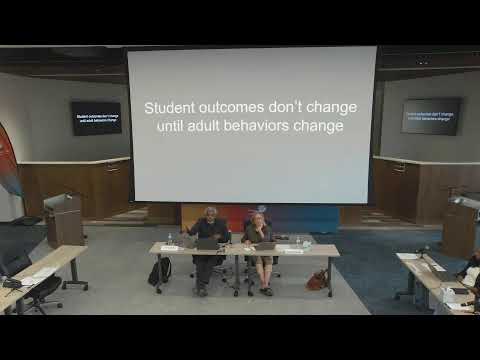
At a work session, the OKCPS board held a two‑hour training on monitoring progress toward the district’s board‑adopted student outcome goals, focusing on how the board and administration will share data, interpret results and act on evidence.
At a work session, the OKCPS board held a two‑hour training on monitoring progress toward the district’s board‑adopted student outcome goals, focusing on how the board and administration will share data, interpret results and act on evidence.
The training, led by outside coaches and staff, emphasized that effective monitoring requires clear interim targets, consistent data series, an expert interpretation by the superintendent and a written plan with evidence — and that root‑cause analysis must accompany any status that is not green.
AJ Curl, a goal‑monitoring coach, told the board that “alignment matters, and part of monitoring progress is to push for and ensure the alignment is actually happening.” He walked members through four required elements of a monitoring report: (1) explicit interim targets and what is being measured; (2) comparable data, preferably showing up to three prior reporting periods so a trend line is visible; (3) the superintendent’s professional interpretation of system performance (for example, red/yellow/green); and (4) evidence and a responsive plan explaining what worked, what did not and what will change next.
Dr. Polk, the district superintendent, told the board that she needs to be able to explain results so principals and teachers can act on them, saying, “If I can’t explain it to them, I promise you we will not be moving.” The trainers and several board members stressed that the superintendent’s interpretation is not optional: it communicates a single, evidence‑based view of system performance to the public and frames the administration’s next steps.
Trainers recommended that monitoring reports be placed on the board packet well in advance — a window of seven to 14 days was suggested, with a staff preference toward 10–14 days — and encouraged board members to submit technical or tactical questions ahead of the meeting so the administration can provide written answers to all members before discussion. The coaches said the board should preserve its limited public meeting time for strategic, results‑focused questions rather than technical or tactical minutiae.
Board members and staff discussed how to treat new data collections. Trainers acknowledged that when an interim metric is new, the first reporting cycles may lack three data points; the administration should present whatever available evidence and explain limitations. If the administration concludes a metric is not predictive or the data source is unreliable, the superintendent may propose changes to interim measures — a step that the coaches said should be used sparingly because it can prompt the board to ask substantive changes to goals or guardrails.
The training also recommended standard presentation formats so board members can compare like with like: a clear restatement of the goal and interim targets at the top of each report, a concise trend graphic, a superintendent interpretation (red/yellow/green or equivalent), and an evidence‑and‑plan section describing fidelity of implementation and next steps. Coaches suggested pairing monitoring with public recognition — for example, inviting students or teachers who show strong growth related to the monitored goal — then moving into a 60–90 minute deep dive on the report.
Several procedural expectations were reinforced: monitoring should be regular (the trainers said this board has chosen a monthly monitoring cadence), questions that require technical answers should be submitted in advance and answered in writing to the whole board, and if a status is not green the report must include a root‑cause analysis that explains why and what the administration will change. If everything is green, coaches said the root‑cause work may still be done internally by staff but is not always required to be presented to the board.
Trainers and board members also discussed governance boundaries. The coaches urged board members not to use the monitoring session for personnel grievances or for management‑level tactical direction; those matters, the training said, are outside the public oversight conversation and, when appropriate, belong in executive session. The coaches warned that repeated tactical questioning in public board meetings can pull the superintendent into day‑to‑day tasks and reduce time spent on strategic leadership.
The session closed with a short practical exercise in which board members practiced drafting “smart” monitoring questions — questions that are strategy focused, measure focused (referencing data in the report), ask‑oriented (open), results‑focused and time‑bound — and contrasted those with “unsmart” questions that are tactical, opinion‑based, closed and future‑speculative. Trainers said the board’s and administration’s shared discipline on question type and timing is central to making monitoring speed continuous improvement.
Before adjournment, the superintendent thanked staff and the board for the work and cooperation. A motion to adjourn was made and seconded and carried by voice vote.