
Council tables Efficiency Maine EV‑charger installation at Prince Memorial Library after parking and site concerns
Get AI-powered insights, summaries, and transcripts
Sign Up Free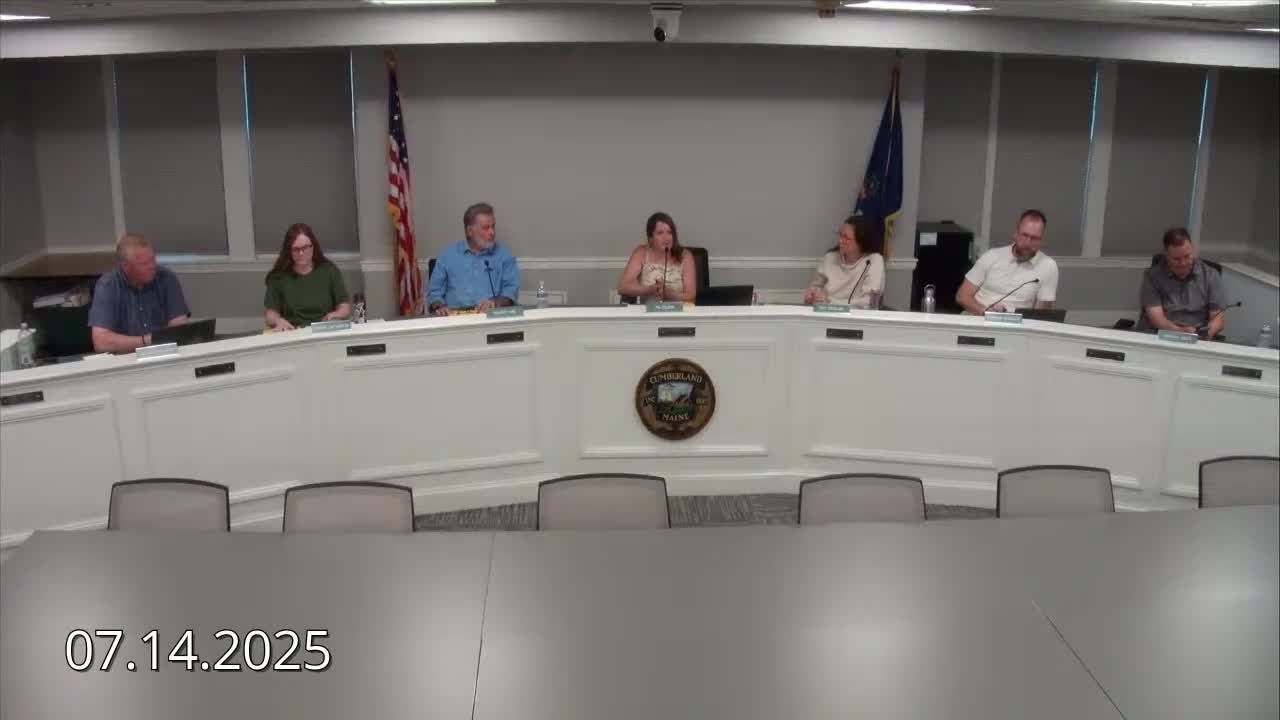
Summary
The Cumberland Town Council on July 14 voted to table a staff recommendation to accept a conditional Efficiency Maine grant to install four electric vehicle charging stations at Prince Memorial Library, citing concerns about limited parking at the library entrance and uncertainty over the best long‑term location.
Lede The Cumberland Town Council on July 14 voted to table a staff recommendation to accept a conditional Efficiency Maine grant to install four electric vehicle charging stations at Prince Memorial Library, citing concerns about limited parking at the library entrance and uncertainty over the best long‑term location.
Nut graf Town staff said the Efficiency Maine program, combined with federal funds, would cover most installation costs. The project would have required a town match of approximately $29,964 from the building fund; Efficiency Maine’s contribution was roughly $40,000 plus available tax credits. Councilors and residents worried the four dedicated parking spaces could be used by non‑EV vehicles at high‑demand times and asked for analysis of alternate town locations such as Valhalla Recreation Center and a town hall site.
Body Town manager Matt Sturgess told the council the grant award depended on availability of federal funding and that Efficiency Maine confirmed the federal funds. The memo in the council packet showed a near‑$100,000 install cost, with Efficiency Maine at about $40,000 and tax incentives offsetting another roughly $30,000, leaving the town match at about $29,964. Sturgess said the town had the match available in its building fund.
Council discussion focused on whether the library’s front‑row parking — the most visible and desirable spaces — was the proper location for chargers that typically require hours of connection for Level‑2 chargers, and how the chargers would be enforced to remain available for charging. Councilor questions included whether chargers would appear on popular charging apps, how revenue collection (staff said users would pay for electricity) would be handled, and how the town would manage ongoing maintenance or replacement costs beyond warranty periods.
Several councilors suggested alternative options: installing chargers at Valhalla Recreation Center where turnover and demand patterns differ, using existing or future parking expansions, or deferring so the town can create a longer‑term parking plan that supports EV infrastructure and community events. Staff cautioned that some electrical work and trenching costs are substantial and relocation later would also be costly.
Vote and next steps Councilor Eades moved to table the item; the motion passed (two councilors opposed). Staff were instructed to continue researching alternative siting options and the council asked that future grant applications come to council for approval before final acceptance. The town manager said tabling now would not permanently forfeit future funding and that Efficiency Maine funds could be re‑applied for if the council later approves a different configuration or location.
Ending Councilors asked staff to include more granular parking and usage analysis in any future resubmittal; the town will also follow up with Efficiency Maine on reapplication timing and on whether the existing conditional award can be preserved while the town evaluates alternatives.