Get Full Government Meeting Transcripts, Videos, & Alerts Forever!
Get email alerts on the Traffic Calming Hicks Road topic
No spam. Unsubscribe anytime.
NDOT proposes speed cushions, ballot and year-long timeline for Hicks Road traffic calming
Summary
Jeff Hammond, a consultant for the Nashville Department of Transportation, presented a draft plan Oct. 12 to slow traffic on Hicks Road between Old Harding Pike and Bellevue Road using speed cushions, explained project data and a ballot process, and answered resident questions about pavement condition and private-access impacts.
Jeff Hammond, a consultant working on behalf of the Nashville Department of Transportation, presented a draft traffic-calming plan for Hicks Road on Oct. 12, outlining data collected, potential engineering tools and next steps that would include a neighborhood ballot and a construction queue.
NDOT’s first recommended treatment for Hicks Road is speed cushions spaced roughly 400–600 feet apart, with an option to use longer, less aggressive cushions in this suburban-to-rural setting. Hammond said the agency would design the cushions to avoid steep slopes and driveways and coordinate with emergency responders.
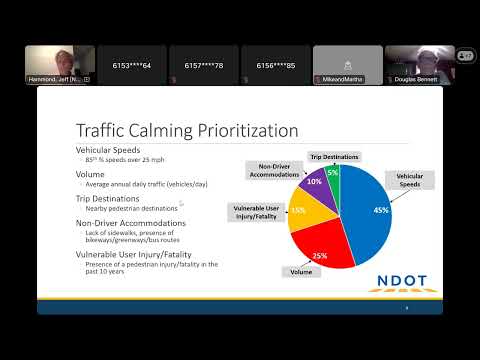
The presenter said the data collected on the project limits — Old Harding Pike to Bellevue Road — showed a representative speed of 42 mph and about 1,100 vehicles per day along the segment; the road width was measured at about 22 feet. Hammond described the scoring used to select projects and said roughly 70% of the selection weight is traffic volume and measured speed, with the remaining 30% addressing vulnerable users and proximity to destinations such as parks, libraries and transit.
"Speed cushions are our number 1 tool," Hammond said, adding that NDOT has installed the molded rubber cushions regularly for about five years and signs them at 20 mph. He said cushions are typically 6 feet wide and 3 inches tall and that NDOT has coordinated designs with emergency responders to avoid unacceptable impacts to fire apparatus.
Residents raised site-specific issues. One resident described a past fatal motorcycle crash in a ravine near Patton Lane and said Chevron signage installed afterward reduced crashes there. A separate resident, Yolanda Coxway, asked whether NDOT would repair a recurring dip in the pavement near Old Harding before installing cushions; Hammond said NDOT staff would flag the location with the roadway manager and check the paving schedule. Councilmember Sherry Weiner said NDOT leadership had driven the length of Hicks Road and was aware of serious pavement and edge failures.
Hammond explained the program’s process and timeline: the neighborhood meeting, a weeks-long design step, a mandatory six-week mailed/online ballot to property owners abutting the project limits, and then placement in the construction queue. He said the ballot is limited to owners of property that abuts the project (with some distinctions for individual condominium unit owners and multi-unit ownership) and that an affirmative two-thirds majority of ballots cast is required to advance the project.
On schedule, Hammond said NDOT generally sees design and then 8–10 months in the construction queue from the point of neighborhood design approval, and cautioned that the project would not be immediate: "We're probably looking at at least 8 to 10 months from this point."
Other potential non-raised options discussed included radar feedback signs, refreshed pavement markings to visually narrow lanes, speed tables (used rarely because they go full width across the road), chicanes and traffic circles; NDOT staff said radar feedback signs are used when cushions are not appropriate or feasible. Residents asked about plow access; Hammond said cushions are placed on snow-plow routes and that plow drivers receive GIS updates showing cushion locations.
Hammond said the draft plan shown at the meeting was flexible and that NDOT would refine spacing, length and exact locations of cushions to limit driveway encroachment and avoid slopes above the program’s thresholds. Residents asked for fewer cushions clustered near Old Harding and for longer cushions (e.g., 14-foot length) that are less aggressive; NDOT staff said they would consider that feedback in the design.
No formal votes or final approvals were recorded at the meeting. NDOT will proceed to design if neighborhood consensus supports the draft; after design the project will be ballot-eligible and then, if the ballot passes the two-thirds threshold, scheduled for construction.
For more information NDOT provided an Engage Nashville dashboard and an email contact, sheri.weiner@nashville.gov, for follow-up questions and private property/ownership clarifications.