Get Full Government Meeting Transcripts, Videos, & Alerts Forever!
Get email alerts on the Landscape Trees topic
No spam. Unsubscribe anytime.
Peachtree City approves landscape plan for 1001 MOBA Drive with requirement to prioritize native Georgia trees if available
Summary
The Planning Commission approved a landscape plan for an industrial building at 1001 MOBA Drive but required the developer to work with staff to substitute nonnative species with Georgia-native trees where they can be sourced.
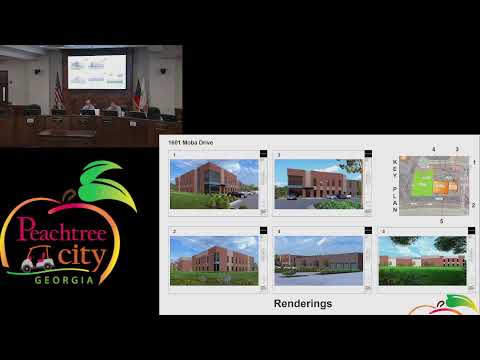
The Peachtree City Planning Commission approved a landscape plan July 14 for an industrial building at 1001 MOBA Drive, with a condition that the developer and staff attempt to substitute nonnative plants with species native to Georgia where those specimens are available. The commission’s action followed staff presentations of required tree-caliper totals and discussion of planting constraints on the site.
Staff told the commission the site, part of the MOBA Industrial Complex, has 205,997 square feet of impervious surface and therefore “the land development ordinance requires them to provide a minimum of 618 caliper inches of canopy trees and 412 caliper inches of understory trees.” The applicant’s plan would plant trees equal to 364 inches of canopy (about 59% of the canopy requirement) and 208 inches of understory (about 51% of the understory requirement), and use the ordinance’s tree-fund compliance method for the remainder.
The site’s 60-foot Tree Save Landscape Buffer along Highway 74 includes a Georgia Power easement that staff said leaves relatively sparse existing tree cover and limits planting locations. Chuck Ogletree, the developer’s representative, said the team had worked with staff and the site’s landscaper “for several months, even actually before we ever even cleared the site … and I think the result is a, it’s a fantastic plan.”
Commissioners focused on species selection. Commissioner Hunter asked whether the developer would substitute Georgia-native species for some nonnative selections and suggested alternatives, saying, for example, “the Mary Nell holly, like an American holly, would something like that work?” The applicant and staff responded that availability and the season make sourcing and transplanting larger trees difficult at this time, but they agreed to explore substitutions with staff.
The commission’s motion, made and seconded during the meeting, approved the landscape plan with the condition that the applicant “work with staff to evaluate substitutions with Georgia native species if available.” The condition was explicit that substitutions be made only if the native specimens are obtainable.
Clarifying details discussed during the item included the ordinance allowance to use the tree-fund method after planting all reasonably plantable trees, the 60-foot corridor affected by a Georgia Power easement, and the applicant’s inclusion of 13 street trees replacing removed specimens. Staff also noted that more than 50% of species proposed are native to the Eastern United States while some — identified in the record as Mary Nell holly, deodar cedar and eastern redcedar — are either hybrids or have native ranges outside central Georgia.
The commission recorded the approval by voice vote and did not record individual roll-call votes in the transcript. The commission also noted that funds paid into the tree fund typically are used to address tree needs elsewhere in the city.