Get Full Government Meeting Transcripts, Videos, & Alerts Forever!
Get email alerts on the Building Permit topic
No spam. Unsubscribe anytime.
Neighbor questions Spokane County permit allowing second dwelling-like structure in 9 Mile Falls
Summary
A 9 Mile Falls resident told commissioners the county issued a permit that effectively allows a second dwelling on a lot despite plat covenants and county permit language limiting structures to incidental storage; he asked for code citations and clarity.
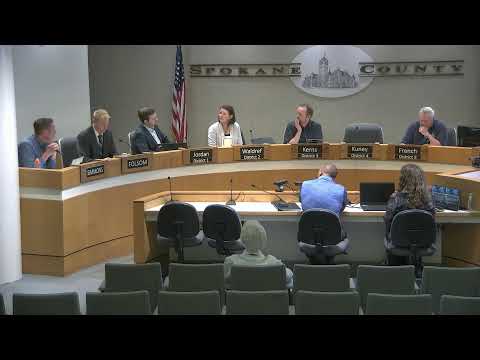
A 9 Mile Falls resident told Spokane County commissioners on July 15 that a county-issued permit has allowed construction of what he says functions as a second dwelling unit on a lot that legally allows only one dwelling. Larry Ike identified himself and said he live[sic] in an established neighborhood in 9 Mile Falls and that the new structure under construction is a two-story building with a 1,230-square-foot shop on the main floor and roughly 1,230 square feet of living space above described as “2 bedroom, 2 bath laundry room, great room, and kitchenette.” He said the original county permit described the structure as a shop and limited it to incidental storage. “The permit issued by Spokane County on this second shop or structure states no stoves, dishwashers, or fixtures and limits the use to incidental residential activities such as storage of private vehicles, farm, and equipment hay storage,” Ike said. He later added that during construction the county began referring to it as a sleeping unit and that he could find no county or International Building Code provision permitting the change. Ike said the subdivision’s recorded plat states no more than one dwelling may be placed on any lot and that subdivision covenants forbid using outbuildings or garages as residences either temporarily or permanently. He said the structure exceeds the county’s ADU size limits if it were treated as an accessory dwelling unit. The resident asked county staff to provide exact code references that justify the permit decision; he said a county official declined to provide the code citations and instead defended the permit by referencing a “kitchenette” rather than a full kitchen. He asked the commissioners to direct staff to supply the specific code sections that support the permit’s current status. Why it matters: the dispute raises questions about permit interpretation, enforcement of subdivision covenants and county zoning/building rules, and whether staff are correctly applying definitions such as “kitchenette,” “sleeping unit,” and ADU standards. Commission staff indicated they would pass the resident’s comments to the county building department for follow up. No formal action or vote was taken on the complaint during the meeting. The resident provided his contact information and asked for written citations to be supplied to him by county staff.