Get Full Government Meeting Transcripts, Videos, & Alerts Forever!
Get email alerts on the Homelessness Encampments topic
No spam. Unsubscribe anytime.
Anchorage administration backs ordinance to ban camping near schools, playgrounds and other ‘high‑risk’ public areas; Assembly schedules public hearing
Summary
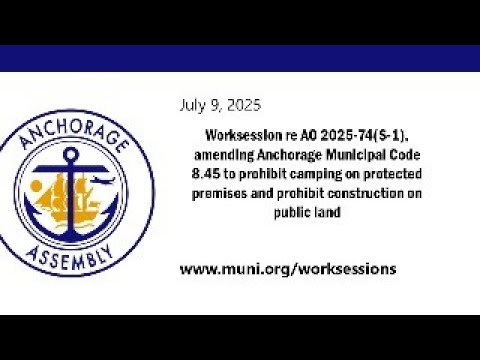
Anchorage Mayor Suzanne LaFrance and municipal attorneys on July 9 presented a revised draft ordinance, AO 2025‑74 S2, that would add criminal penalties for unauthorized camping and for constructing or occupying unauthorized structures in designated “sensitive” public areas such as playgrounds, school grounds, athletic fields, sidewalks, trails and near high‑speed roads.
Anchorage Mayor Suzanne LaFrance and municipal attorneys on July 9 presented a revised draft ordinance, AO 2025‑74 S2, that would add criminal penalties for unauthorized camping and for constructing or occupying unauthorized structures in designated “sensitive” public areas such as playgrounds, school grounds, athletic fields, sidewalks, trails and near high‑speed roads. The Assembly held a work session to review the S2 version and set a public hearing for Friday at 1:00 p.m. in Assembly Chambers; the body did not vote on the ordinance at the session.
The proposal, the administration said, is intended to be a narrowly targeted enforcement tool to prevent camps from becoming entrenched in areas that pose heightened risks to public health and safety. “The AO wouldn't be successful without this groundwork,” Mayor Suzanne LaFrance said, and she described recent investments the city has made to expand shelter and outreach. Deputy Municipal Attorney Joseph Fusa told the Assembly the S2 draft “creates new criminal penalties for unauthorized camping in the most sensitive areas” and also adds penalties for constructing or knowingly occupying unauthorized structures on public land.
Why it matters: Administration officials framed AO 2025‑74 S2 as an additional tool to shorten the time it takes to remove dangerous, long‑term encampments and to protect children and other park users from hazards the city described — including accumulated trash and needles. The administration said the proposal is not intended to criminalize all outdoor sleeping and that enforcement would focus on specified buffer zones around the most sensitive sites; the S2 draft also narrows potential fines compared with an earlier S1 draft, officials said.
What the administration told the Assembly: LaFrance and senior staff highlighted recent work the city says supports the proposal: they reported $5,500,000 in federal emergency rental assistance and $2,500,000 in Community Development Block Grant (CDBG) funding secured to support year‑round shelter, greater APD staffing from the ongoing academy (the administration described a target of 386 sworn officers plus 19 community service officers), expansion of outreach and the Healthy Spaces cleanup team, and 28 camps abated in the last year. Fusa said S2 refines the camping definition to focus on “overnight sleeping or the substantial equivalent thereof” to avoid unintentionally capturing brief naps or daytime resting.
Enforcement and discretion: Anchorage Police Department officials and outreach teams described how the city would use the ordinance if adopted. Brian Wilson, deputy chief of operations for APD, said calls about camping would be prioritized alongside other public‑safety calls and that specialized teams — the HOPE team and MIT (Mobile Intervention Team) — would be primary responders for these incidents, with patrol backing up as needed. “Our entire approach to the camping situation is based on reasonableness,” Wilson said. Lieutenant Brian Fuchs of APD’s HOPE team described repeated efforts to obtain voluntary compliance during abatements and said his team has prioritized outreach: “My team has taken excessive steps to ensure that we get some level of voluntary compliance.” Prosecutor Dennis Wheeler said prosecution would generally seek compliance rather than maximum penalties and noted therapeutic courts and diversion options may be available in some cases, but he also warned those treatment resources are limited and that diversion depends on availability.
Questions and concerns from the Assembly: Members pressed administration officials on several issues, including whether the city’s shelter and treatment capacity is sufficient to support a criminalization approach, how enforcement would be implemented consistently across officers, the cost to municipal departments, and how the S2 draft differs in practice from existing criminal trespass and civil abatement tools. Assemblymembers asked for clarity about the ordinance’s geographic buffers, who counts as a person with “apparent authority” to order someone to leave, and whether federal land or private property would be affected. The administration repeatedly said S2 is meant to apply only to a limited set of high‑priority public areas and does not replace civil abatement or other existing authorities.
Data and operational context provided to the Assembly: Officials cited several operational figures during the session. The administration said outreach and abatements have moved people into shelter and services — for example, about 50 people associated with the Davis Park abatement entered shelter, housing or treatment — and that cleanup of entrenched sites has been resource‑intensive; the administration reported that Davis Park and the snow‑dump cleanup had yielded about 744,000 pounds of trash and required about 1,914 person‑hours as of July 8. Officials also described plans for a pre‑charge diversion program and said a working group with the courts is being discussed to expand therapeutic‑court capacity.
No vote, next steps: The Assembly did not vote on AO 2025‑74 at the July 9 work session. Members were told the ordinance will return for a public hearing on Friday at 1:00 p.m. in Assembly Chambers; the Assembly also anticipates an executive‑session briefing from the Department of Law on liability issues. Administration staff said they will provide training guidance, implementation plans and evaluation metrics if the ordinance moves forward.
What remained unresolved: Several members urged additional written explanation of how the S2 draft differs in enforcement effect from existing criminal‑trespass and civil‑abatement codes, and they sought clearer commitments on provider capacity and shelter availability. Administration officials confirmed there is no guarantee of shelter space at the moment and acknowledged therapeutic courts and treatment‑bed capacity are limited. The work session closed with members asking for follow‑up materials and for robust evaluation metrics if the law is enacted.
Ending: The Assembly will hold the S2 public hearing Friday at 1:00 p.m. in Assembly Chambers and may consider amendments or further briefing at subsequent meetings.