
Manhattan staff outline 2026 recommended budget; commissioners debate mill-levy scenarios, COLA and use of reserves
Get AI-powered insights, summaries, and transcripts
Subscribe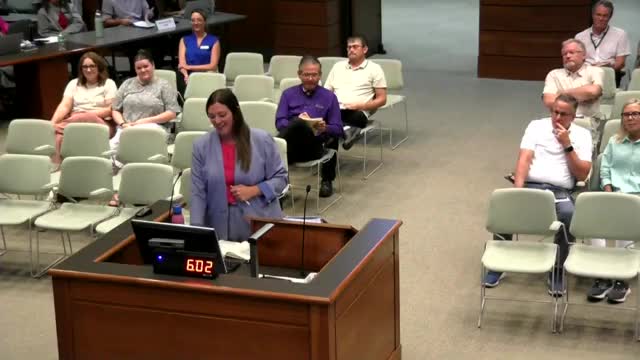
Summary
City staff presented a $174.7 million 2026 recommended budget on July 8, 2025. Commissioners pressed for clarification on tax-change math, library and social-services funding, street maintenance, and options that would fund a 3% cost-of-living increase.
Manhattan city staff presented the recommended 2026 budget at a July 8 work session, telling the City Commission the proposed total expenditures across all funds are $174,698,648 against projected revenues of $166,957,405 and outlining three mill-levy scenarios that trade off employee cost-of-living adjustments, equipment and building maintenance, and the use of fund balances.
The presentation laid out the budget calendar and outreach schedule and summarized key assumptions and changes. Staff said the recommendation assumes a 3% increase in water and wastewater rates, a 6% increase in stormwater rates, and a conservative 1.5% growth in sales tax revenue. Staff also described projected property-tax growth of about $1.4 million from assessed valuation increases plus an additional $847,000 tied to a hypothetical 1.134-mill increase, producing roughly $2.5 million in additional property-tax revenue under the assumptions shown.
Danielle, the presenting city staff member, said the recommended budget reflects an intentional use of special-revenue fund balances for projects and identified two debt-service payments coming online in 2026 for a joint maintenance facility and North Campus Corridor Phase 9 that help push debt-service spending to about $22.4 million. The presentation noted utilities’ combined actual expenditures were approximately $31.2 million in 2024 and are projected near $40 million in 2026. “We are projecting a 3% increase in water and wastewater rates,” Danielle said during the presentation.
Staff reviewed special-revenue funds including sales tax allocations (the city uses half of the 1¢ sales tax for special revenue), the economic-development sales tax split (70% for debt/infrastructure, 30% for grants and jobs programs), and the transient-guest tax (used for the Convention & Visitors Bureau, the Manhattan Arts Center and other outside agencies). Outside-agency funding recommendations held most recipients flat at their 2025 levels; staff recommended holding Flint Hills Area Transportation Agency to its 2025 funding level despite an ATA request for an increase and continued a five-year commitment of $200,000 annually to Manhattan Area Technical College (2026 would be year three of five).
The recommended general-fund budget showed a net decrease of about $460,000 from the 2025 budget; staff attributed part of that to transferring animal control to the Riley County Police Department (a savings on the order of $300,000 was cited). The draft does not include any COLA (cost-of-living adjustment) for employees or firefighters but does include expected promotions and firefighter step increases. Staff estimated a 3% COLA would cost about $750,000.
Staff offered three levy/benefit scenarios for commissioner feedback: Scenario A would require roughly a 1.03–1.04 mill levy increase and include no COLA, vehicle/equipment replacement or building maintenance; Scenario B would fund a 3% COLA with no vehicle/building replacements and would require about a 2-mill levy increase; Scenario C would fund a 3% COLA plus $750,000 of deferred vehicle/equipment replacement and building maintenance and would require approximately a 3-mill levy increase.
Commissioners pressed staff for clearer reconciliations between percentage changes and dollar amounts for the city, police and library levies. One commissioner said the combined tax increase appeared to be about 6% overall and asked why the city portion and police portion did not align; staff pointed to motor-vehicle and other state-provided figures that feed into levy calculations and agreed to follow up with detailed reconciliation.
Commissioners raised several policy issues for further direction: the city’s use of carryover balances and whether the $11 million in carryover should be spent on capital needs now or conserved for future years; whether social-service grant funds should prioritize “basic human needs” programs rather than spreading small sums across many groups; whether transient-guest-tax dollars should subsidize parking or other tourism-related infrastructure; and the adequacy of parking-fund revenues to cover garage expenses. Staff confirmed the parking management fund’s planned revenues and expenditures roughly break even in the current proposal.
Public commenters addressed the budget in turn. Gary Ols praised the presentation and urged thoughtful decisions on priorities; Jerry Bachman urged the commission to increase street maintenance funding, calling the current streets “a horrendous mess”; Andrew Von Lintel urged the commission to seek revenue neutrality and avoid raising property taxes if possible.
The commission also adopted a procedural motion at the start of the session allowing public comments to be held at the end of each presentation and the end of commission questions; the motion passed unanimously. The work session produced no final appropriation or mill-levy vote; staff said commissioners must set the revenue-neutral rate and take action on levy decisions at a later meeting, and staff asked for feedback ahead of the July 15 agenda where the revenue-neutral discussion is scheduled.
The presentation and the questions that followed set the stage for further staff follow-up on tax-reconciliation detail, library and social-service funding alignment, parking-fund analysis, and a list of capital projects that commissioners want prioritized from carryover funds. Staff also reminded commissioners of public open houses in August and the traditional budget hearing on Sept. 2, with adoption expected Sept. 16 under the city’s one-reading adoption process.
Commissioners and staff recommended additional review and clarification before any levy-setting decisions at the next meeting. Public comment closed and the commission adjourned at the end of the session.