Get Full Government Meeting Transcripts, Videos, & Alerts Forever!
Get email alerts on the Downtown Consumption topic
No spam. Unsubscribe anytime.
Commission adopts downtown common consumption area ordinance after debate; vote 3-2
Summary
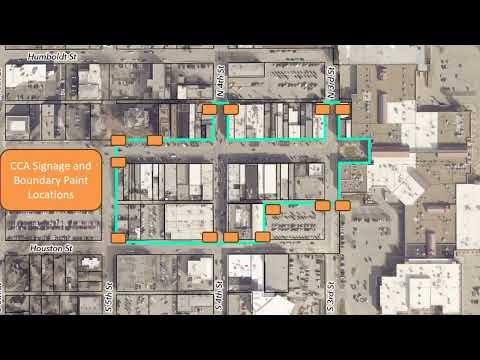
The Manhattan City Commission on June 17 adopted Ordinance 7760 to create a downtown common consumption area allowing patrons from participating licensed establishments to carry alcohol within a defined downtown boundary from 8 a.m. to 11 p.m.
The Manhattan City Commission on June 17 adopted Ordinance 7760 to establish a permanent downtown common consumption area (CCA) that will allow patrons of participating licensed establishments to carry alcohol within a mapped downtown boundary from 8 a.m. to 11 p.m.
Jared Wasseringer, assistant city manager, described the ordinance and the administrative steps needed if the commission approved the boundary: the city would apply to the Kansas Alcoholic Beverage Control (ABC) for a CCA permit, pay a $100 annual state fee, and require participating licensees to complete state ABC forms and a city participant permit (a $250 annual fee). Wasseringer said the city would also publish informational signage and an FAQ for businesses and the public.
Wasseringer detailed operational rules discussed with stakeholders, including the state ABC and RCPD: licensed providers must use a single‑serve, non‑glass container that displays the licensee’s identifying mark; businesses may apply for a noncontiguous service-area permit to sell from a sidewalk or outdoor location adjacent to their premises; and the city manager would have authority to suspend the CCA for a specific special event. "We're gonna have to look at every special event that wants to happen inside this area because they're gonna be special events that don't want alcohol," Wasseringer said.
Commissioners and stakeholders asked multiple questions about enforcement, effects on nonparticipating businesses, trash, underage drinking and the cost of implementation. Commissioner Opelt pressed how nonlicensee businesses should enforce nonparticipation and whether youth or inexperienced staff would face undue liability. In response, staff and Gina (a DMI representative) said the downtown business association has discussed the concept for years, that dining platforms have already tested some elements and that the district would conduct outreach and provide uniform signage (including a "no alcohol inside" sticker for nonparticipating businesses).
Public comment was split. Andrew Von Lintel (2254 Winds Court) said he opposed expanding bridge spending in an unrelated consent-item discussion but later told commissioners he supported testing the CCA and suggested temporary signage could be removed if problems arose. Amber Starling (408 Houston Street) urged the commission to delay or deny the ordinance, arguing the staff presentation lacked quantitative demand data, risk mitigation plans, and a cost breakdown for implementation and enforcement. Starling told the commission she had worked in emergency services and was concerned that "drunk pedestrians plus cars equals trouble."
Supporters and some commissioners framed the ordinance as an entertainment-district tool to increase foot traffic and sales. Staff said the downtown boundary would allow vehicle traffic to continue except during fully closed special events, and that the CCA would be in effect during ordinary third-Thursday events unless suspended by the city manager. The ordinance also renames the city’s "assembly permit" to a "demonstration permit" and clarifies related application routing to staff and RCPD.
At roll call, the ordinance passed 3-2: Commissioner Mota — yes; Commissioner Minton — yes; Mayor McCullough — no; Commissioner Adamczyk — yes; Commissioner Opelt — no. The ordinance directs staff to apply for the state permit, publish rules, print and install boundary signage and begin outreach to licensees with the goal of mid‑July implementation ahead of a scheduled third‑Thursday event. The city manager retains authority to temporarily suspend the CCA for special events or other reasons.
Commissioners asked staff to return with a status update; one commissioner requested a six‑month follow-up report including data on incidents, underage drinking and business feedback.