Get Full Government Meeting Transcripts, Videos, & Alerts Forever!
Get email alerts on the Wastewater Treatment topic
No spam. Unsubscribe anytime.
City hears update on wastewater treatment solids upgrade; GMP expected this fall
Summary
City utilities staff and contractor teams updated the commission on a solids upgrade and expansion at the wastewater treatment plant, reporting a 90% design, a preliminary $25 million cost benchmark from the 60% model and a plan to submit a guaranteed maximum price this fall; construction is projected to begin October 2025 and take 18–24 months.
Manhattan City Commissioners heard an update on the wastewater treatment plant solids upgrade and expansion project from Public Utilities staff and the CMAR (construction manager at-risk) team, who said they will submit a guaranteed maximum price (GMP) to the city this fall.
The project team — Kevin Niles, director of public utilities; Garrett Sheehan of Corolla Engineering; and Joe Barnes of Crossland/Crossland Heavy — described an upgrade that touches every part of the plant’s solids process. The plant’s liquid stream capacity was boosted to 11 million gallons per day (MGD) in 2013; project presenters said the solids-processing equipment has not seen major improvements since 2004 and now requires replacement, modernization and automation to improve digestion, thickening and regulatory adaptability.
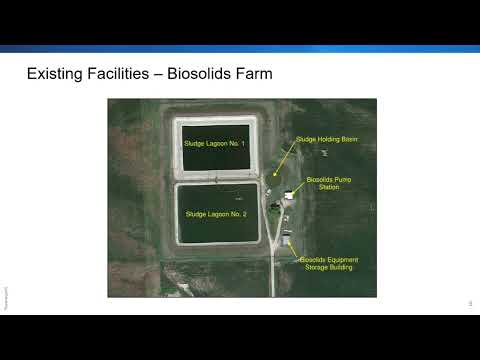
The upgrade is intended to enhance process performance, redundancy, resiliency and reliability; optimize operations; and preserve the city’s autonomy over biosolids management. Plant staff noted that processed biosolids are stored in sludge lagoons and applied to city-managed farmland; presenters said the project aims to produce a biosolid that can be routed to multiple treatment or disposal options in the future.
Contracting and cost: Joe Barnes, the CMAR representative, said Crossland delivered a detailed cost model tied to the 90% design and was reaching out to the market for current pricing and allowances. The team reported the 60% cost model at roughly $25,000,000; the 90% model remains subject to market pricing, allowances and contingencies and will be finalized as the GMP. Barnes said the team expects to have a lockable price to present at the end of the month and to submit the GMP to the city for review this fall.
Schedule and scope: Presenters said the project reached 90% design in mid‑2025, with construction—subject to acceptable GMP and commission approval—planned to begin in October 2025. The construction schedule was given as an 18–24 month window, with a target of mid‑2027 for completion and commissioning timed to the spring application season for biosolids.
Operational and technical details: Garrett Sheehan described major plant-wide work including increased digestion capacity and thickening systems. He explained a planned improvement at the lagoons to aid washdown: instead of running a new long run of 6‑inch supply pipe, the team proposes installing a 10,000‑gallon storage tank and booster pumps to overcome an existing 2‑inch supply limitation. Sheehan and Niles said building a more optimized sludge thickening system will make future technology add‑ons (for emerging contaminants such as PFAS) easier to integrate but that regulatory change remains uncertain.
Financing: Kevin Niles told the commission the city is about 10% invested in the project to date. He said KDHE loan funding is not available (KDHE reportedly has no loan funds remaining), and the city plans to pursue a city bond (CO bond) for the remainder of the project financing. Commissioners asked about cost increases since initial 2022 planning; Niles attributed the rise to a mix of scope changes and market/economic conditions.
Commission direction and public comment: Commissioners did not take a formal vote to approve construction tonight. The commission voted earlier in the meeting to allow public comment on agenda items (motion carried; five commissioners recorded “yes”), and during this agenda item commissioners indicated support for staff to continue work with the CMAR and return with the GMP and associated financing details. No final construction contract was approved at the meeting.
Why it matters: The plant serves Manhattan’s wastewater needs and processes biosolids that the city applies to land. Upgrades are intended to protect regulatory compliance, improve reliability and preserve local control over biosolids operations while responding to a market and regulatory environment that project presenters described as uncertain.
Sources: Presentation and Q&A with Kevin Niles (Director of Public Utilities), Garrett Sheehan (Corolla Engineering) and Joe Barnes (Crossland/Crossland Heavy) during the Manhattan City Commission work session. Details on the cost model, tank sizing and schedule were stated by those speakers during the presentation.
Ending: City staff indicated they will bring the finalized GMP and any recommended changes (scope adjustments or descopes for cost control) back to the commission for review in late summer/early fall before construction would begin.