
Lane County task force recommends phased approach to shore up policing, jail and prosecution funding
Get AI-powered insights, summaries, and transcripts
Subscribe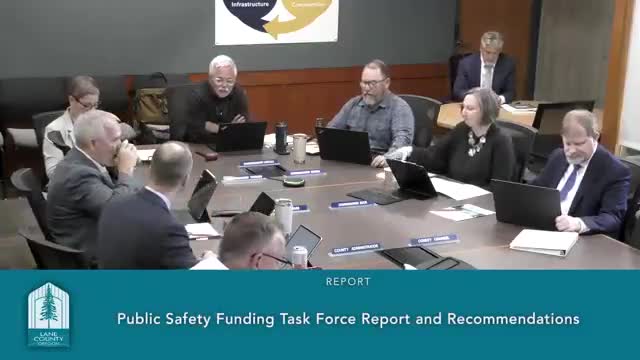
Summary
A citizen-staff task force convened by the Lane County Board of Commissioners recommends beginning with investments in policing, the jail and the district attorney's office while pursuing efficiency, targeted audits and voter-facing revenue tools to address a multi-year funding gap.
The Lane County Board of Commissioners received a year-long report from the Public Safety Funding Task Force on June 25, 2025, urging a phased approach that starts by stabilizing rural patrol, jail operations and the district attorney's office.
The task force, made up of 11 volunteer members and supported by county staff, spent roughly 18 meetings and more than 42 hours studying fiscal and operational shortfalls across the county's public safety system and recommended concentrating initial resources where the group found the clearest linkage between public safety response and downstream services.
The nut graf: The group concluded that policing, the jail and prosecution are the most interdependent parts of the system and that shoring up those areas first would enable better access to behavioral health, deflection and supervision services that rely on timely law enforcement and prosecutorial action.
Task force members told the board that 74% of the county's discretionary general fund is already committed to public safety and that ongoing structural pressures ' including constrained local revenue growth, changing payer mixes for related services, and wide geographic variation in demand ' make a single, immediate fix unlikely. The panel estimated a range of needs depending on the scope: roughly $27 million per year to raise rural patrol and DA staffing toward a regional benchmark, about $55 million to stabilize jail funding off temporary levies, and a larger, higher-end figure (roughly $95 million) reflecting the full county public-safety general-fund picture. The task force did not recommend a single funding instrument to cover every scenario.
The report lays out a mix of near-term steps and potential revenue tools. Near-term recommendations include: targeted efficiency reviews and audits to identify savings, incremental "small wins" to demonstrate progress to the public, and phased investments that can be scaled up. The task force also evaluated voter-facing options ' including a payroll tax, a public-safety district, and charter amendments that would dedicate or prioritize funds for public safety ' but flagged each as legally and politically complex and requiring more detailed analysis and public engagement.
Task force leaders told the board the payroll-tax option could generate material revenue at scale but would be politically sensitive and would require extensive outreach and design work to avoid regressive impacts on lower-income workers and to address differences between incorporated employment centers and unincorporated rural areas. The group recommended extensive polling and stakeholder engagement before advancing any revenue measure to voters.
The report emphasized measurement and accountability. The task force pressed departments for operational metrics (for example, deputies per thousand population and prosecutorial workload measures) and urged the board to require near-term performance reporting that voters could understand. Members argued that showing incremental improvements and transparency around spending would build the trust needed for a later revenue request.
Board members and task force co-chairs discussed implementation timelines and feasibility. County staff and elected officials warned that hiring and training 68 additional deputies (the task force's illustrative deputies-per-thousand benchmark) would require several years and tens of millions of dollars in annual personnel and operating costs; task force discussion projected a multi-year ramp rather than an immediate staff surge.
What happens next: The board acknowledged the report and discussed creating recurring staff work sessions to translate the recommendations into defined options for the public and for potential ballot measures; commissioners said they want the task force's materials, additional data and more stakeholder outreach before committing to a specific funding path. The board did not adopt a funding measure during the meeting.
Ending: The task force passed its final report to the board for follow-up work sessions; commissioners asked staff to return with implementation options, further analysis of tools evaluated by the task force, and community-engagement plans.