
Police present crisis-intervention K9 plan; council signals support for grant applications
Get AI-powered insights, summaries, and transcripts
Subscribe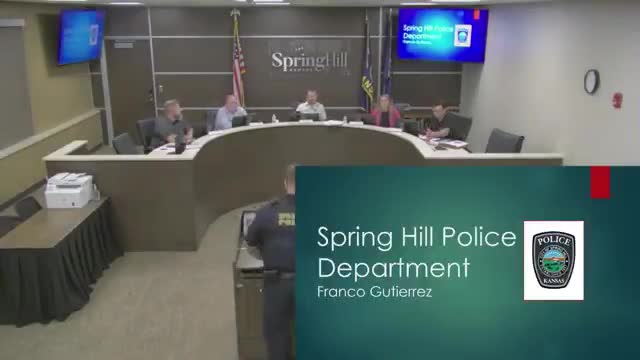
Summary
Spring Hill Police proposed a crisis-intervention canine to support mental-health response, victim interviews and officer wellness and outlined grant and department-fund options to cover start-up costs.
Spring Hill Police presented a proposal for a crisis-intervention canine (cert K9) to assist officers on mental-health crisis calls, critical incidents and community engagement.
Sergeant Gutierrez described the cert K9 role as an emotional-support and de-escalation tool that can detect chemical and hormone changes and encourage victims to open up during interviews. Sgt. Gutierrez said the dogs are trained for crowded public events, to provide calming contact (hugs and light petting) and to assist in debriefs and officer wellness after traumatic incidents. The presentation referenced other agencies in the metro that deploy similar canines and said handlers coordinate regionally if another jurisdiction needs assistance.
Costs and funding: Sgt. Gutierrez and staff outlined acquisition and operating costs: Guide Dogs of the Desert donation/acquisition approximately $7,500; a dedicated vehicle and kennel system and equipment estimated around $70,000; plus uniforming, training and recurring veterinary and food expenses. Staff said some foundations and grant sources are available (Canines United, National Police Dog Foundation, Spirit of Blue, Guide Dogs of the Desert and other canine foundations). The police department proposed using grant proceeds where available and relying on the department’s drug-and-alcohol and special-alcohol funds to cover remaining costs; staff said available fund balances are approximately $38,000 (fight addiction fund) and $165,000 (special-alcohol fund).
Training, operations and coverage: presenters said Guide Dogs of the Desert advertises a one-day handler-canine transition training because the dogs are trained extensively before delivery. The handler would carry regular patrol duties and be expected to bring the dog to community events; the vehicle/kennel approach presented would allow handling of prisoner transports while the handler is assigned the K9. Staff said additional agencies in the metro are willing to coordinate deployments when available.
Council response: council members and the police captain expressed support and encouraged staff to pursue grant funding. Captain and council members noted community engagement benefits and potential use in debriefs, juvenile victim interviews and suicide-prevention responses. One councilor summarized clear direction as: “go get grants.” No formal appropriation vote was taken at the meeting; staff said they would apply for grants and return if funding gaps required council appropriation.
Next steps: staff will pursue external grants, refine budget estimates, and present any required appropriation requests to council if grants do not fully cover acquisition and first-year costs.