Shawnee council reviews 2026 budget overview, staffing changes and transient guest tax increase proposal
Loading...
Summary
City Manager Paul Kramer asked the Shawnee City Council whether to include a proposed increase of the city’s transient guest tax from 8% to 9% in the city manager’s proposed 2026 budget and presented updates on fund balances, reserve reduction and three staffing changes; council discussion was mixed and no formal vote was taken.
City Manager Paul Kramer told the Shawnee City Council at its July meeting that staff will present the city manager’s proposed 2026 budget on July 28 and asked the council for direction on whether to include a proposed increase in the city’s transient guest tax from 8% to the 9% cap allowed by charter ordinance.
Kramer said the city’s “all funds” balance is shown on the presentation as about $82.1 million and that the general fund accounts for roughly 47.8% of that total. He described the all-funds figure as a snapshot that can swing when the city makes large payments — citing a midyear interest-only credit-card payment and a December principal-and-interest payment that together affect the debt service fund.
The presentation also covered the reserve reduction plan. Kramer said the council’s three-year plan is on track: the general fund reserve target is 45% by the end of 2025 and the presentation showed the city is essentially on target at about 45.2%. He said the council previously directed staff to reduce reserves, and that the city used reserves in 2024 for projects including the Mill Valley stormwater work and an insurance risk-mitigation fund.
Kramer outlined three staffing changes planned for 2026 that he said do not increase general fund expenditures: funding one additional police-dispatch position by reallocating existing alcohol-mitigation/education funds (a portion of which the city uses to pay a share of school resource officers); reallocating a position from the city manager’s office to public works to create a construction-inspection role; and converting a part-time adaptive-recreation coordinator to full time to support Camp Shawnee if the program increases to the charter limit of 105 campers. Kramer said the police dispatch team has 11 full-time dispatchers “since the mid-nineties” while neighboring Lenexa has 17, and that monthly transmissions increased by roughly 3,000 from 2023 to 2024.
On the transient guest tax, Kramer reminded the council that a charter ordinance allows the city to levy up to 9%. The current rate, set by a 2020 resolution, is 8%. Kramer said 2 percentage points already go to Johnson County Park and Recreation District (JCPRD) for the Mid-America Sports Complex through 2030 and 1 percentage point funds Visit Shawnee and Shawnee Town 1929 operations. Kramer said 2024 transient guest tax revenue totaled about $960,000 and that nearby cities including Olathe, Overland Park and Mission set their rates at 9% while Lenexa, Kansas City, Kansas, and others are at 8%.
Staff recommended raising the rate to 9% and suggested the additional revenue could support visitor-focused projects such as World Cup 2026-related needs, Rail Creek Park, the Midland Entertainment District and downtown events. Council members expressed mixed views: some said a 1% increase equals only about $2 on a $200 hotel room and would largely fall on visitors; others warned that repeatedly raising a visitor tax could make Shawnee less competitive or discourage stays. Several council members said they were cautious about approaching 10% as a psychological threshold. Council members asked for occupancy and hotel-count data; staff said Shawnee has about five hotels and roughly 440 rooms and that platform-collected short-term rentals pay the same rate and generate about $80,000–$90,000 annually.
Kramer asked for a show of hands in support of including a 9% rate in the proposed 2026 budget. The transcript shows informal indications of support and opposition but records no formal motion or roll-call vote on the tax rate that night.
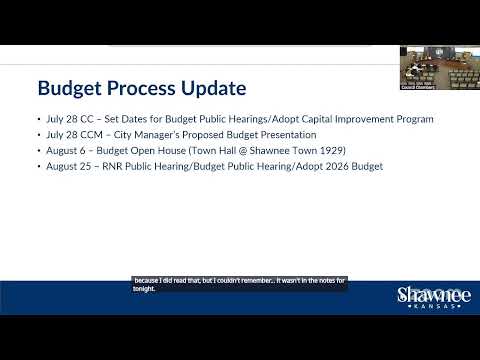
Kramer closed with scheduling notes: the city manager’s proposed budget presentation and adoption of the capital-improvement plan are set for July 28; a budget open house at Town Hall is scheduled for Aug. 6; and the revenue-neutral rate public hearing, budget public hearing and the council vote on the 2026 budget are scheduled for Aug. 25.
The meeting concluded with an adjournment motion that passed by voice vote.