Get Full Government Meeting Transcripts, Videos, & Alerts Forever!
Get email alerts on the Parks Fees Budget topic
No spam. Unsubscribe anytime.
Lawrence Parks and Recreation proposes membership fees, reduced-rate option and free after‑school hours to help close budget gap
Summary
Lawrence Parks and Recreation staff presented a proposed membership and fee structure at the June Parks and Recreation Advisory Board meeting to help offset expected budget reductions and preserve core services.
Lawrence Parks and Recreation staff presented a proposed membership and fee structure at the June Parks and Recreation Advisory Board meeting to help offset expected budget reductions and preserve core services.
At the June meeting, Lindsey Hart, assistant director, said the proposal would create daily passes, punch cards, and monthly and annual memberships with resident and nonresident pricing, plus a separate, deeply reduced “qualified” rate for residents demonstrating financial hardship. “The purpose of the fee structure is, number 1, to protect essential services while obviously meeting city wide budget reduction goals,” Hart said.
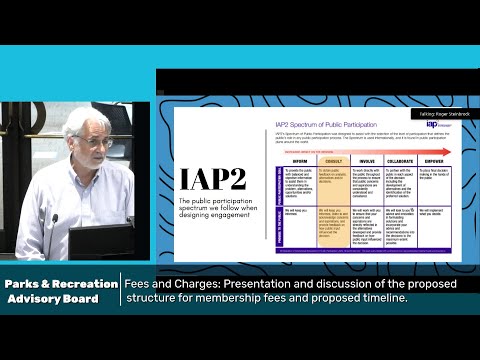
The proposal emerged from a community engagement process that included an online survey, pop‑up events and planned focus groups. Staff reported 2,632 survey responses and 1,353 open comments; two of four planned pop‑ups had been completed and the initial focus group with budget‑committee members had 12 participants. Porter (community engagement staff) and other project staff described the engagement as consultative under the International Association for Public Participation (IAP2) framework.
Why it matters: Staff said fees are intended to reduce the scale of service cuts the department faces. Hart said the plan would “help preserve core programming, retain staff, and avoid closures,” and that fee revenue would help offset a parks and recreation share of larger city budget reductions. Staff repeated the city’s budget context at the meeting: the city must close a multi‑million dollar gap this year and the parks division was facing roughly $1.1 million in required reductions as part of the balancing process.
Key elements of the proposed structure
- Two membership packages: an all‑facility pass covering Sports Pavilion Lawrence (SPL), East Lawrence Recreation Center and Holcomb Recreation Center; and a neighborhood package limited to East Lawrence and Holcomb at a lower price point. - Price tiers by age and household: adults 18–59; seniors 60 and older; youth 5–17; household memberships up to five people with at least one adult at the same address. - Resident and nonresident pricing: staff said they plan to charge nonresidents roughly 20% more than resident rates; “resident” is proposed to mean City of Lawrence street addresses (not Douglas County). - Qualified reduced rate: a streamlined, low‑barrier application for residents in financial need that staff said would be about 60% lower than standard rates for annual memberships and punch cards. Staff said they will accept existing eligibility determinations from other agencies (for example, school free/reduced lunch letters or KanCare documentation) to reduce paperwork. - Youth access: free after‑school access for youth (ages 5–17) Monday–Friday from 3–5 p.m. and on early‑release Wednesdays from 1–5 p.m. at Holcomb, East Lawrence, SPL and the community building. - Other revenue options under consideration: tournament fees for visiting teams and events, and in time possibly program‑level resident/nonresident differentials.
Staff said the qualified reduced rate and a separate scholarship program will operate differently: scholarship funding for programs (camps, leagues, classes) is limited and will remain its own fund, while the qualified membership rate is intended as an unlimited discounted price tied to household eligibility.
Questions and community concerns
Board members and public commenters pressed staff on details that remain under development. Several asked when actual dollar amounts would be available; Hart said specific rates were not being released at the advisory‑board meeting because staff are still testing figures with focus groups and analyzing survey feedback. She said proposed rates will be presented to the City Commission in mid‑July and that the commission agenda will be published the Thursday before that meeting.
John Nalbandian, a board member, urged staff to include comparable cities and median incomes in the materials to show how Lawrence’s proposed rates compare with peers. Taylor, a board member, asked whether the community building would remain open; staff said the community building would not be closed but could have reduced public hours and more limited staffing unless fee revenue or other funding reduces the need for service cuts.
Public commenters voiced concern about access and awareness. Eric Sartorius (resident, ZIP 66046) framed the discussion in the city’s fiscal context: “This year's budget, as you know, needs to be cut about 6 and a half million to get back into fiscal balance,” he said. A resident identified only as Sid said SPL is “something very unique to Lawrence” and warned that residents might not learn about qualified discounts or free youth hours unless the city communicates them broadly.
Timing and next steps
Staff outlined a timeline tied to the city budget process: the proposed budget will go to the commission in early July, staff will return to the advisory board for feedback the day before the commission discussion, and the commission will consider the proposal on July 15 (agenda to be published the prior Thursday), with continued refinement through the summer as the final budget is adopted in the fall.
No formal vote or decision on rates occurred at the advisory‑board meeting. Board members emphasized their advisory role: the board will provide recommendations and feedback to staff, and the City Commission will make the final decision on any new fee policy.
What remains unresolved
Staff said several operational details are still in development: how the city will verify Lawrence residency (options discussed included address, ZIP‑code or existing access cards), the mechanics for issuing and scanning membership cards, exact dollar amounts for resident/nonresident and qualified rates, and any changes to program‑level fees. Staff also said they will continue testing rates with focus groups and post the outreach findings on the project web page.
Ending note
Staff asked the board to continue collecting community feedback; they plan further pop‑ups and two follow‑up focus groups and said they will include comparative market data and income context in the July materials for the commission and the advisory board.