Get Full Government Meeting Transcripts, Videos, & Alerts Forever!
Get email alerts on the Transportation Safety topic
No spam. Unsubscribe anytime.
Lawrence advisory board adopts Vision 0 transportation safety plan; backs federal grant application for corridor studies and pedestrian pilots
Summary
The Connected City Advisory Board unanimously approved the Vision 0 transportation safety action plan and voted to provide a letter of support for a Safe Streets and Roads for All (SS4A) grant application to fund corridor studies and a leading pedestrian-interval pilot on key downtown and school crossings.
The Connected City Advisory Board voted unanimously May 19 to approve the Vision 0 transportation safety action plan and to provide a letter of support for a federal Safe Streets and Roads for All (SS4A) grant application seeking funds for corridor studies and a pilot of leading pedestrian intervals.
The action plan lays out a “safe systems” approach that recognizes human error and seeks to design streets to reduce the severity of crashes, city staff said. The plan cites a 32-mile “high-injury network” that represents 6.5% of Lawrence’s roadway mileage but accounted for 64.8% of the city’s injury crashes and 66.2% of its fatal and disabling crashes in the 2018–2022 data window.
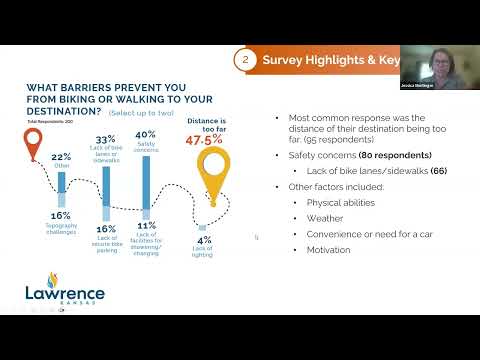
Jessica (staff member) presented the plan, saying the Vision 0 work is data driven and that the city intends to target resources at the high-injury network. “This approach, around Vision 0 and the safe systems approach acknowledges that there's human vulnerability and error,” Jessica said. She described the plan’s public engagement, a 211-response online survey and pop-up events that covered Lawrence, Eudora and Baldwin City, and a dashboard the city will publish with crash data supplied by KDOT.
Why this matters: The plan provides a policy and project framework that the city says will guide engineering, enforcement, education and emergency response work to reduce deaths and serious injuries on city streets. Adoption also clears the way for specific follow-up work the board discussed: corridor-focused safety audits, an application for SS4A funding to support those audits and concept development, and demonstration installations of leading pedestrian intervals at select signalized crossings.
Board discussion and questions focused on tradeoffs between mobility and safety, how the high-injury network was defined and whether demographic data tied to crashes could be used. Board member Nick asked how the plan reconciles the city’s need to move traffic quickly with the safety focus; Jessica said the two goals “are in conflict” and must be balanced through engineering such as access management, raised medians and signal timing.
On data and method, Jessica and staff said the high-injury network and a separate high-risk analysis rely on crash severity and more than 20 risk factors; the plan’s technical appendix describes the methodology. Jessica noted a companion dashboard will allow the public to view individual crash point data and track before-and-after effects as projects are implemented.
Grant application and pilot work: Staff presented a proposed SS4A application that would fund corridor studies on Sixth Street and 20th Street and a demonstration of leading pedestrian intervals (LPIs) at downtown and Safe Routes to School signalized crossings. Dave (staff member) described the LPI treatment: “It gives the pedestrians the ability to start walking across the crosswalk before it gives the green light for the through traffic.” He said intersection context — volumes, turning movements and corridor signal coordination — will determine where LPIs are appropriate.
Jessica said the city’s current estimate for the package of planning and demonstration work is roughly $400,000 in combined grant and match funding; she also noted a maximum eligible request for planning and demonstration under the solicitation could be up to $5,000,000, though the city does not currently expect to request that maximum and has no committed local budget for a large construction package. Staff said they had submitted a separate Build Kansas request to help fund local match.
Public comment and equity concerns: Samuel Carter, a member of the public, urged the board to add feasibility studies for three additional corridors and to develop a complementary safety plan focused on children and young adults. Carter said he found many crash-related addresses in mobile home developments and expressed concern that lower-income residents may be disproportionately affected: “I noticed a disturbing trend that there's kids who live in mobile home developments are disproportionately affected by crashes.” Jessica and staff clarified that the Vision 0 mapping and analysis focus on crash locations (infrastructure risk), not residence addresses, but said they were working with state and federal partners to determine what demographic information is appropriate to include in planning while complying with guidance.
Formal actions: The board approved the Vision 0 Transportation Safety Action Plan and separately approved a motion to provide a letter of support for the SS4A planning and demonstration application. Both measures passed unanimously; the transcript indicates the votes were taken by voice and recorded as unanimous, though individual roll-call vote names were not recorded in the meeting minutes provided.
Next steps: Staff said they will finalize the Vision 0 dashboard, pursue the SS4A application with a request for corridor planning and demonstration funding, and prepare a draft resolution for the City Commission that would commit the city to a long-term goal of zero traffic deaths and serious injuries by 2050. The board also asked staff to clarify crash analyses (including age and, where allowable, demographic overlays) and to provide more detailed corridor statistics for forthcoming grant materials.
Additional context: The Vision 0 project was funded through the federal Safe Streets and Roads for All program and includes elements intended to align with the city's long-range Transportation 2050 plan; staff said federal investment likely will be required to implement many of the engineering recommendations in the plan.