Get Full Government Meeting Transcripts, Videos, & Alerts Forever!
Get email alerts on the Capital Improvement Plan topic
No spam. Unsubscribe anytime.
Lawrence staff outline 2026–2030 capital improvement plan, flag $470 million in unfunded needs
Summary
City staff presented the proposed 2026–2030 capital improvement plan (CIP) to the Connected City Advisory Board on June 16, outlining funded projects, revenue sources and a $470 million list of unfunded requests that the City Commission will be asked to prioritize.
City staff presented the proposed 2026–2030 capital improvement plan (CIP) to the Connected City Advisory Board on June 16, outlining funded projects, funding sources and a long unfunded list the city will ask the commission to prioritize.
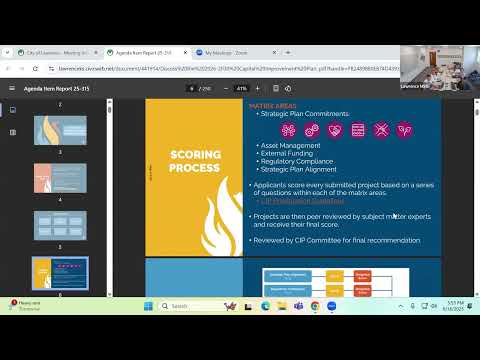
Melinda Harger, assistant director for MSO, told the advisory board that the CIP is a five‑year planning tool and that a project must generally cost $100,000 or more to be included. "If the to be a CIP project, the project must cost a 100,000 or more," Harger said, and she described the scoring and peer‑review process used to prioritize projects.
The proposed plan includes a mix of bond‑funded and cash projects and shows a substantial list of unfunded requests. Harger said departments and public submit requests and an internal CIP committee scores and recommends projects; peer reviewers include asset management, budgeting staff and regulatory leads such as Evan (ADA administrator) and Trevor (water/wastewater staff). She said the city received about $140 million in new project requests during the latest open call and that the total unfunded need in the draft CIP is roughly $470 million.
Why it matters: the advisory discussion stressed trade‑offs between ongoing street maintenance and one‑time capital projects. A recurring choice for the commission will be whether to preserve street maintenance funding levels or shift dollars to discrete projects such as the 20th/Seventh Street bridge repair, Harvard reconstruction, or loop/connector projects.
Key points from staff presentation
- Funding sources and constraints: the CIP combines general obligation (GO) bonds, revenue bonds (backed by utilities), capital infrastructure sales tax proceeds, federal and state grants, and other funds. Harger explained revenue bonds are repaid with utility rates; general obligation bonds are backed by the government's full faith and credit.
- Capital infrastructure sales tax: staff framed the dedicated 0.3 percent capital infrastructure sales tax as a major funding source for sidewalks, ADA transition work and street maintenance. Harger said the full ADA transition plan is a roughly 20‑year, $100 million effort; the CIP currently shows about $5.2 million per year ramping up to address sidewalks and right‑of‑way accessibility.
- Pavement Condition Index (PCI): the city's PCI target is 70; current PCI is about 63. Staff said, at current funding levels, the PCI is projected to reach only about 64–65, and fully funding backlog projects would likely take 10–20 years.
- Unfunded vs. funded projects: staff identified priority projects now classified as unfunded, including the West of K‑10 water storage (formerly a pressure zone project that was redefined), portions of the Southeast conveyance corridor, and a newly elevated need to repair the 20th/Seventh Street bridge following bridge inspections. Harger said some projects are development driven and will depend on timing of growth; others are maintenance that staff recommend bond‑funding when the useful life justifies it.
- Street maintenance program: staff explained the contracted street maintenance program is funded from a mix of gas tax, capital infrastructure sales tax and geo debt (bonding). Portions of some contract work can be capitalized when it extends useful life; routine mill‑and‑overlay is generally O&M and not capitalized.
- Benefit districts: staff described planned 'benefit district' items for areas where developers will pay a majority of project costs and the city will pay enhancements. Benefit districts are on the unfunded list so commissioners are aware of potential future assessments tied to development.
- MSO campus, solid waste and vehicle funding: MSO Campus Phase 2 appears in the CIP with mixed funding; Harger said solid‑waste operations are not yet large enough to support standalone revenue bonds and portions are shown as GO debt and cash. Harger and other staff said vehicle and apparatus replacement timing and procurement lead times (notably for fire apparatus) are driving important timing decisions.
Discussion and context
Board members asked about how the CIP draws the line between maintenance and capital projects, and Harger explained the finance standards used to capitalize portions of street and waterline projects that extend asset useful life. Board members pressed for clarity on specific projects — Harvard reconstruction (moved out of the street maintenance pot into a standalone project because of its severity), the Lawrence Loop timing, and the West Lawrence/South Lawrence Trafficway (K‑10/SLT) utility relocations that are already under contract.
Harger said the finance team uses conservative growth assumptions (2% sales tax growth, 4% mill levy growth) for debt capacity modeling. She cautioned that federal tariffs, market conditions and grant availability introduce uncertainty in out‑year cost estimates.
No formal board action; next steps
No formal advisory board vote was taken on the CIP at this meeting. Harger said the recommended CIP will be presented to the City Commission on June 17; the operating budget and five‑year CIP are typically adopted at a September commission meeting (staff noted the operating budget adoption is scheduled for Sept. 16). Staff asked the advisory board to return with any policy questions (for example, whether the capital infrastructure sales tax should be renewed or narrowed) when the board reviews the recommended CIP in July or August.
Ending
Staff provided a full project workbook and said project detail sheets are available for board members who want a line‑by‑line review. Harger and other staff recommended additional advisory discussion on funding priorities, the capital sales tax renewal timing (the tax expires in March 2029), and the relationship between street maintenance funding and other capital priorities.