
Council pushes decision on temporary concrete batch plants after resident concerns
Get AI-powered insights, summaries, and transcripts
Sign Up Free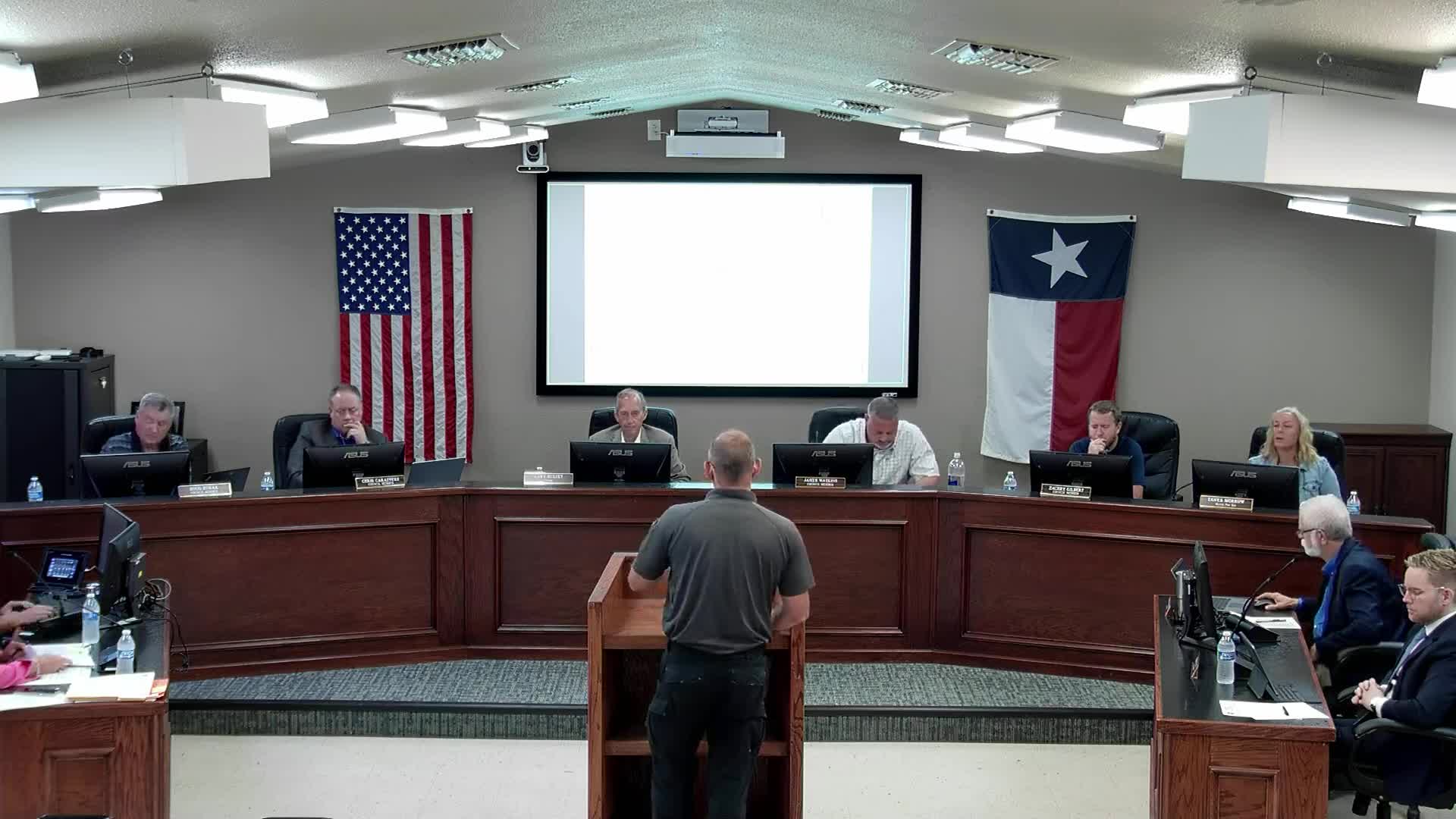
Summary
Council continued decisions on temporary concrete batch-plant permits for Northglenn and Sweetgrass subdivisions to Aug. 4 so developers can provide data on truck counts, duration and mitigation measures.
The Haslet City Council voted to continue consideration of two temporary concrete batch-plant special-use permit applications — one for Northglenn Subdivision Phase 3 and one for Sweetgrass Subdivision Phase 2 — until the Aug. 4 meeting to allow developers to supply additional data requested by council and residents.
Why it matters: Neighbors near both sites raised concerns about dust, truck traffic, noise and potential impacts on pools and property during public hearings. The Texas Commission on Environmental Quality (TCEQ) had issued or received applications for both plants; staff noted TCEQ modeling and permit materials are included in the packet but council members and residents asked for clearer local information and mitigation commitments.
Details from the hearing: Michael Thetford explained both SUP applications: Northglenn had a unanimous Planning & Zoning recommendation to approve; Sweetgrass also had a unanimous Planning & Zoning recommendation. Residents from Arbor Lane and Ashmore Farms said the plant at Northglenn was already in place and worried about dust and trucks near their backyards. Douglas Scott (313 Arbor Lane) told council, “I'm opposed to it. Since they started that construction over there, I'm spending more money cleaning my pool.” Tom Coleman (301 Arbor Lane) said earlier earthwork had already caused dust-control issues.
Developers’ responses: Randy McQuiston, representing the Cambridge Companies (developer of Northglenn), said his paving contractor, Glenn Thurman Inc., submitted the application and explained technical differences between pouring slabs and paving streets. McQuiston said the batch plant reduces concrete truck trips on local streets and described TCEQ-required dust-control measures, including moisture control of aggregates and sealed cement silos. He said vapor emissions sometimes look alarming but are water vapor and are not hazardous.
Key technical and regulatory details raised at the meeting: - TCEQ application excerpts in the council packet list distances from emission release points: 318 feet (one site) and 395 feet to nearest off-property structure (Northglenn example); another site listed 426 feet and 761 feet for Sweetgrass. Those distances are taken from the TCEQ exhibits in the packet. - Hours discussed: applicants indicated typical construction hours 7 a.m. to 6–7 p.m. - Length of operation: conflicting statements in documents and at the meeting — the TCEQ application lists “1 week” in a field; staff reported applicants told them “two months.” The city ordinance allows up to 90 days for a temporary plant.
Council action: Councilmember motioned and council voted unanimously to continue both Northglenn and Sweetgrass SUP items to the Aug. 4 meeting to allow the applicant/developer to provide specific data requested by council (estimated additional concrete-truck volumes if the plant is not allowed, the number of truck trips, placement alternatives, dust-control plans and exact duration). The motion specified the Aug. 4 meeting to avoid re‑noticing.
Ending: The continuance requires applicants to provide clearer metrics and mitigation commitments; council members said they want the paving contractor to attend the Aug. 4 meeting to explain operational details and dust-control measures.