Round Rock ISD reports K–2 literacy, early math gains; Purple Sage Elementary credits intensive interventions
Loading...
Summary
District and campus leaders told the board the district made measurable gains in early literacy and early math and showcased Purple Sage Elementary’s weekly Student Success Team and early‑intervention practices as drivers of campus improvement.
District staff told the Round Rock ISD Board of Trustees on Tuesday that the district met or exceeded several board targets for early literacy and showed notable year‑over‑year gains in early math, and Principal Sarah Nelson described how Purple Sage Elementary used frequent progress monitoring and an intervention block to lift student performance.
Dr. Nichols, presenting Lone Star Governance monitoring on early literacy, said districtwide third‑grade projections tied to early screening rose year over year: the district’s all‑students group improved about six percentage points to 70 percent on the composite literacy metric used for K–2 screening. K–2 screening uses MCLASS in English and Spanish; when a student was assessed in both languages the higher score is reflected.
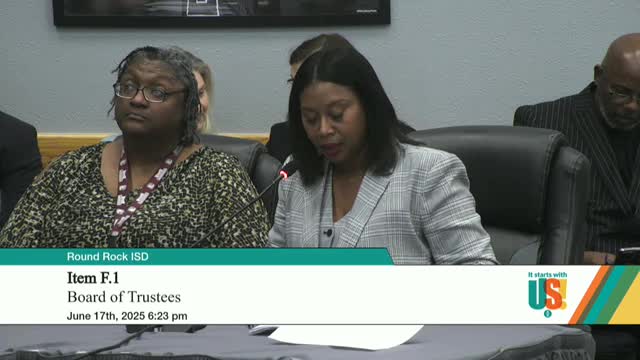
At the campus level, Principal Sarah Nelson said Purple Sage exceeded its kindergarten target, finishing the year at 87 percent at or above benchmark. Nelson said the school drills down to students who miss benchmarks and meets weekly with an interventionist-led Student Success Team to adjust instruction. "We do create a watch list of students based off of their previous year data... and we meet weekly to talk about student gains, student losses and the why behind it," Nelson told trustees. She described in-class intervention, tiered groups no larger than four for intervention and an email protocol to parents after each SST meeting.
District presenters emphasized the impact of pre‑K 4: students who attended the district’s pre‑K program were overrepresented among economically disadvantaged groups but performed near the district average on screening measures, a point staff cited as evidence the pre‑K offering improves readiness. Presenters cautioned that some student groups — economically disadvantaged students, students with disabilities and some emerging bilingual students — remain below targets and will require focused growth.
On early math, the district said it uses AIMSweb data in grades K–2 and correlates the 40th percentile threshold as a marker of on‑track status for third‑grade STAAR math expectations. Kindergarten early‑math performance grew from 58 percent at the start of the year to 71 percent by spring benchmark, short of a 77 percent goal but representing a multiyear improvement, staff said. The district reported stronger cohort gains when students remain in the system from kindergarten through second grade.
Trustees asked about test‑to‑test differences, summer slide and why beginning‑of‑year screeners can show students scoring lower than the previous year’s end‑of‑year: staff answered that the assessments are not identical from one administration to the next and that beginning‑of‑year screens measure a new set of expectations.
Nelson credited campus processes — weekly SST meetings led by an interventionist, early intervention within four to six weeks when data indicate need, protected flex time so students do not miss tier‑1 instruction, and a practice of exiting students as they meet targets — for year‑end gains. "We have to make sure that there's progress monitoring... and we're listening to our data," she said.
District leaders said progress will continue to be monitored and that principals and teachers will continue professional development tied to new math curriculum rollouts and district intervention protocols.