Plano ISD reports early TSIA results, CTE progress as CCMR metric shifts
Loading...
Summary
Plano ISD presented preliminary Texas Success Initiative (TSIA) results for 10th graders and a career readiness update showing gains in concentrator/completer status and industry‑based certifications; district officials emphasized more embedded preparation and data tracking to raise college‑ and career‑readiness (CCMR) rates.
Plano ISD administrators updated the school board Tuesday on college, career and military readiness (CCMR) metrics, including the district’s first district‑wide TSIA testing of 10th graders and recent changes to how career and technical education (CTE) is counted toward CCMR.
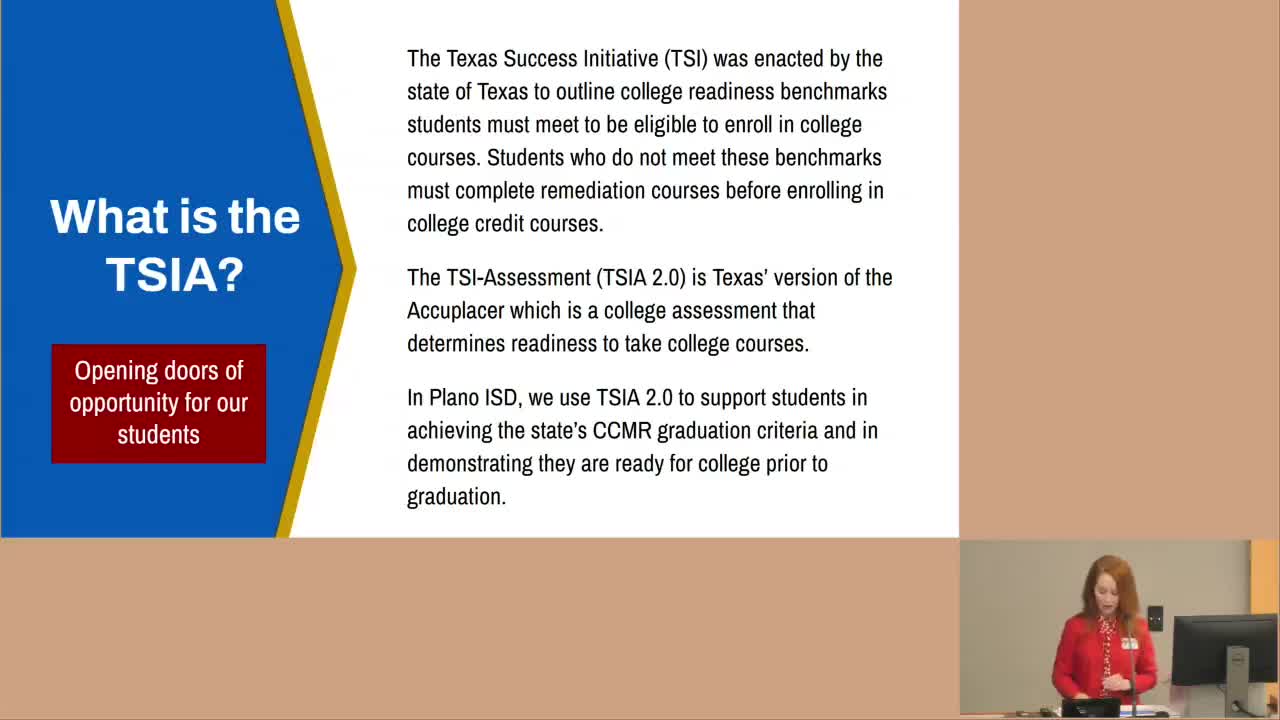
Dr. Kristen Edney, executive director for counseling, CCMR and advanced academics, reported that TSIA testing this spring was given in reading and writing to 3,011 sophomores; 1,439 students (48%) met the state benchmark on the TSIA reading/writing multiple‑choice portion, and 1,168 students met the essay benchmark. Of the students who completed both assessments, 925 (39%) met the benchmark for both tests. Edney and staff characterized the effort as an initial baseline and said more embedded practice would likely raise scores.
“Two great benefits” of earlier and district‑wide TSIA testing, Edney said, are better support for students seeking dual credit and earlier diagnostic reporting campuses can use to target interventions. Edney said the district did not test all students for TSIA math this year — only those seeking dual credit math — but that secondary academic services and math coordinators will work to build math testing and intervention pathways in coming years.
Karen Beekman, director of CTE, reviewed changes in state CCMR policy and how they affect local program design. For the class of 2025 the district counted CTE students who were “concentrators” (two or more high‑school CTE courses totaling at least two credits within a program of study) and who earned an industry‑based certification (IBC). Beekman described a trend to stricter statewide rules: next year students are expected to be “completers” (three or more courses totaling at least four credits, including a level‑3 or level‑4 course) and also earn an IBC.
Beekman said earlier entry points and expanded middle‑school offerings that earn high‑school credit have increased the pipeline; she reported that 69% of the class of 2025 are projected to graduate as CTE concentrators or completers, and that the number of unique students earning IBCs increased by about 200 this year even though the raw count of certifications dipped when the state removed several previously accepted certifications from the approved lists.
Dr. Edney gave a preliminary CCMR tally for the class of 2025 of about 85% meeting CCMR (data remain in flux as AP/IB/dual‑credit records and other external feeds continue to be verified). “CCMR is an octopus,” she said, describing the many data sources the district must reconcile. District staff said SchoolLinks is helping by providing near‑real‑time tracking of students’ CCMR indicators.
Administrators outlined next steps: embed TSIA practice into earlier grades, build internal capacity (training English, math and AVID teachers as in‑house test experts), use diagnostic reports to guide interventions, continue to expand CTE offerings aligned to state IBC lists, and tighten local tracking of students taking examinations and earning credentials.
No board vote was required for the report; trustees asked clarifying questions about timelines, certification lists and district capacity to scale supports.