Get Full Government Meeting Transcripts, Videos, & Alerts Forever!
Get email alerts on the Artificial Turf Health topic
No spam. Unsubscribe anytime.
Parent group urges LTISD to test high school turf for crumb rubber carcinogens
Summary
A parent and advocacy-group director told the Lake Travis ISD board the district must disclose artificial-turf infill locations and test crumb-rubber samples after linking local cancer cases to the material; he offered to fund third-party tests.
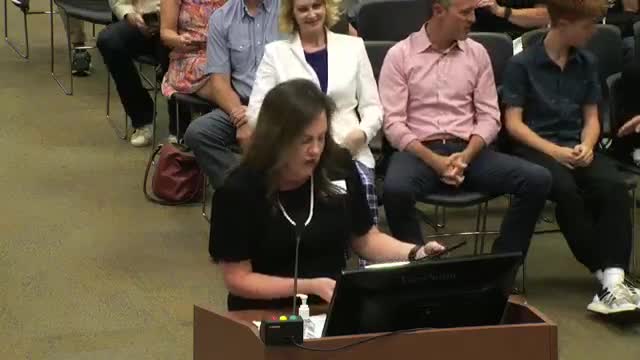
Michael Herman, director of the Zachary Cole Foundation, asked the Lake Travis ISD board on June 9 to test the district’s artificial-turf crumb-rubber infill and to disclose where the material is used.
Herman described the foundation’s work memorializing his son, a former Lake Travis athlete who died of a rare leukemia, and said public data show a cluster of deaths in the ZIP code since 2012. He told the board crumb rubber — reclaimed tire infill used in many synthetic fields — contains chemicals such as benzene, arsenic and lead and that the material degrades and becomes airborne at high temperatures.
"Crumb rubber is the infill in artificial turf made from recycled tires. It contains carcinogens like benzene, arsenic, and lead," Herman said. He urged trustees to require disclosure and to post signage at fields that use the infill, asserting that other jurisdictions and organizations have restricted or banned crumb rubber.
Herman also offered a three-way test: "Take 3 samples of crumb rubber, have it tested, 1 for the district, 1 we'll take and 1 by a random parent — we will pay the Zachary Cole Foundation for these tests and we will make the results public," he said. He referenced international and domestic actions limiting crumb rubber and cited concerns about symptom overlap between chemical exposure and concussion.
District staff did not take action in open session during the meeting; Herman’s request was part of the public-comment agenda. Trustees did not announce a testing plan at the meeting. The floor of the boardroom earlier that evening hosted several athletics recognitions, where staff noted widespread district participation in competitions and turf use for athletic facilities.
Herman asked the board to treat disclosure similarly to other public-health incidents: "If this were lead in the water fountains, would you tell the parents? If it was asbestos in the walls, would the building still be open?" he asked.
The board did not announce a vote or a directive at the meeting. Herman’s remarks were recorded in the public record and give the district a formal, public request to consider testing, signage and disclosure about turf infill materials.