Get Full Government Meeting Transcripts, Videos, & Alerts Forever!
Get email alerts on the Parking Management topic
No spam. Unsubscribe anytime.
Delray DDA, merchants and valets clash over downtown parking plan; board opposes centralized valet
Summary
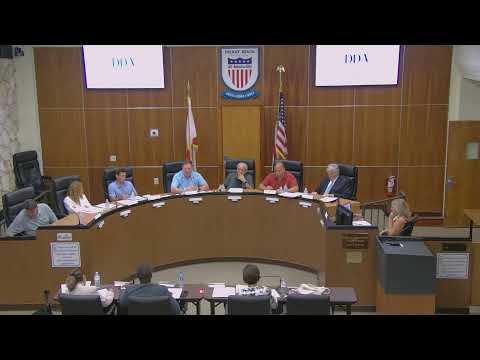
The Delray Beach Downtown Development Authority on July 14 took up the city’s draft downtown parking and curbside-management plan and heard merchants, valet operators and residents warn that proposed meters, a centralized valet program and new lot rules could reduce customer turnover and strain employees.
The Delray Beach Downtown Development Authority on July 14 took up the city’s draft downtown parking and curbside-management plan and heard more than a dozen public speakers — restaurant and retail owners, valet operators and residents — who warned proposed changes could hurt employees, reduce turnover of customer spaces and make access harder for elderly and disabled patrons.
The DDA’s discussion focused on three principal topics in the city proposal: changing meter hours and rates on Atlantic Avenue and side streets; metering and time limits in surface lots such as the Railroad and Gladiola lots; and a city proposal to centralize valet operations into hub lots. DDA members and multiple speakers told the board they want more public engagement and asked city staff to reconsider a centralized valet model and to study using downtown garages as employee parking.
DDA staff member Laura Simon summarized the city’s presentation: Atlantic Avenue currently is $4 per hour with a three-hour limit; the city proposed beginning enforcement one hour earlier, at 11 a.m., but not raising the rate. Side-street meter rates currently near $2 per hour were proposed by the city to increase to $3 per hour and begin at 11 a.m. Surface lots that are now free or timed would receive new metering and a 4-hour maximum under the city proposal. The DDA’s written response recommended limiting new charges in some lots, keeping railroad lot parking free until late afternoon with a lower evening rate, and pursuing a differentiated approach to peak and off-season pricing.
Board members and many speakers urged a measured approach rather than an across-the-board rollout. “For valet to work, it needs to be efficient, and it needs to be fast,” said Todd Herbst, who identified himself as an owner of City Oyster, Alisa Bettas and Rocco’s Tacos. He and other restaurant owners said centralizing pickup and drop-off in lots away from the Avenue will lengthen retrieval times, increase downtown circulation of vehicles and make valet less useful for patrons seeking quick access. John Powers, who identified himself as owner/operator of Valet Q’s, and other long-time valet operators said many private lots currently used by valets would not be available for a centralized program, that insurance and logistics would become more difficult, and that the city already enforces valet operations through code enforcement staff.
Retail and restaurant employees raised concerns about new fees for workers who park long shifts. “This would massively affect our employee parking,” said Samintra Mohammed, director of business management for Periwinkle, Morley & Coco and Co., who described staff earning near minimum wage and said an added daily parking cost would affect hiring and turnover. Several retail owners and managers described relying on the Railroad lot and nearby lots for staff and asked that a portion remain free or that a subsidized employee program be developed.
Many speakers urged use of Delray’s parking garages to absorb employee parking and to keep garage parking free as a management tool. DDA members said the board has previously proposed using underutilized upper garage levels for employees and suggested the commission consider that option again. The DDA presentation also recommended a “parking benefits” enterprise fund (earmarked parking revenue returned to downtown parking needs) rather than routing all meter revenue to the city general fund.
Valet operators pointed out that the current decentralized model depends on private agreements with landowners to secure off‑street inventory; replacing that with a centralized hub may remove the private lots that make valet practical. Dave Leonard, who identified himself as providing valet service at Elizabetha’s, listed possible operational issues (insurance, inclement weather, longer retrieval times, and app-based retrieval problems for older patrons) that could arise with satellite pickup locations.
Board members indicated strong support for two positions after the public remarks: (1) the DDA opposed the city’s centralized-valet proposal in its present form and asked for more study and stakeholder engagement; and (2) the DDA asked city commission and staff to revisit the possibility of making downtown parking garages free for employees/customers as part of a comprehensive management plan. Those requests were expressed as board consensus rather than as a formal vote.
The board also recommended more public outreach and workshops before city implementation. Several speakers asked for phased or pilot programs, clearer data on where new revenue would go, and better notification to downtown businesses before plans are adopted. The DDA scheduled a town-hall meeting on Aug. 13 to gather further input on parking, and members said they would forward the board’s written recommendations to the city.
Less-central items: the DDA presentation also described the in‑lieu parking program (established in the 1970s) and recommended clarifying whether in‑lieu funds are dedicated to parking projects or are flowing to the general fund. The DDA reiterated a prior request to create a parking benefits fund to capture meter revenue and reinvest it locally.
The board did not adopt a formal ordinance or motion about the city plan at the July 14 meeting; members instead asked staff to use the comments to shape a formal DDA position to be transmitted to the City Commission and to participate in further workshops.
Looking ahead, the city commission was scheduled to continue its review of the curbside/parking plan the day after the DDA meeting; the DDA asked commissioners and staff to consider the board’s concerns — especially about centralized valet and employee parking — before finalizing implementation.