Get Full Government Meeting Transcripts, Videos, & Alerts Forever!
Get email alerts on the Career Technical Education topic
No spam. Unsubscribe anytime.
Katy ISD expands Raines Academy programs, lays groundwork for virtual high school under new state law
Summary
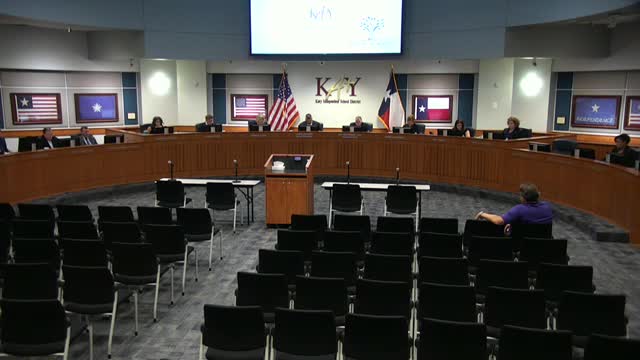
Katy Independent School District trustees on June 23 heard a detailed update on Raines Academy’s hybrid and career-technical programs and were briefed on district plans to stand up a KISD-run virtual high school under recently passed Senate Bill 569.
Katy Independent School District trustees on June 23 heard a detailed update on Raines Academy’s hybrid and career-technical programs and were briefed on district plans to stand up a KISD-run virtual high school under recently passed Senate Bill 569.
The presentation, led by Raines Principal Richard Merriman, described programs that include a commercial driver’s license (CDL) pathway (79 students served across five cohorts), a new water-operations licensing apprenticeship launching fall 2025, a two-year dual-credit real-estate program, and industry-certification opportunities and paid student work experiences across central office and operations departments. “Raines Academy creates innovative learning experiences and provides unparalleled growth opportunities to inspire our students to create a better tomorrow,” Merriman told the board.
District staff and trustees framed the Raines work as part of a larger “complex” that includes Miller Career Center and other CTE facilities. Carrie Sanguinetti, who leads virtual and CTE coordination for the district, told trustees that virtual original-credit coursework “is something we’ve been doing for quite a while in Katy ISD over 10 years” and that the district already runs multiple summer virtual semesters and 37 unique online courses this summer.
Why it matters: leaders said the mix of in-person, hybrid and virtual options is intended to increase student choice and provide direct workforce pathways for students who do not pursue a four-year degree. The board was also warned that Miller Career Center is at capacity: staff reported roughly 3,000 course requests for Miller this year, with roughly 1,950 accepted and about 800 students waitlisted. District planners are evaluating reuse or relocation of the Opportunity Awareness Center (OAC) and options to create a “Miller 2” or other campus expansion to add seats for CTE programs.
Program details and questions from trustees: - CDL and employer partnerships: Merriman and staff said the program covers the initial cost and training for students (typical private CDL training cited at about $8,000–$10,000) and that the district works to place students in entry-level positions with employers who typically assume insurance costs for young drivers. Merriman gave Waste Management as a district contractor that recently hired a program graduate and said portable credentials such as forklift certification are being added to create stepping-stone opportunities.
- Water-operations apprenticeship: The district plans an apprenticeship tied to a clean- and wastewater certificate with local employers such as Inframark and described shuttling students to worksites for practicum experience.
- Real-estate dual credit: the two-year program is largely virtual and culminates in practicum experiences with local real-estate offices; graduates will be eligible to sit for the Texas real-estate license exam after meeting course requirements.
- Capacity and scheduling: staff said Raines supports 375–450 students at a time and can serve up to 500 in the building, but enrollment fluctuates because graduates may leave midyear after completing requirements. Leslie Hack (strategic design lead) and others said flexible scheduling allows students to take a mix of in-person and asynchronous virtual courses so they need not choose between extracurriculars and career training.
- Apprenticeship expansion and employer outreach: staff described a forthcoming advisory council, employer job fair in August, and coordinated apprenticeship pilots across water operations, CDL and HVAC/construction trades beginning this fall.
State law and a virtual campus: Leslie Hack briefed trustees on Senate Bill 569 — state legislation the district said expands options for districts to offer virtual and hybrid education and supports sustainable funding for those models. Staff outlined two virtual program tracks for 2026–27 planning: (1) a continued “a la carte” model that lets students take individual virtual courses (already in operation) and (2) a full-time KISD virtual high school that would enroll in‑district students (who could retain home-campus extracurricular participation) and out-of-district students under TEA rulemaking and an application process. Carrie Sanguinetti said the district intends to aggregate virtual course demand, support teacher professional development for virtual instruction, and explore out-of-district tuition that could produce revenue if TEA’s application and funding rules permit it.
Board concerns and next steps: trustees pressed staff about insurance and employer uptake for young CDL drivers, the limits on Miller’s capacity, and how the district would prioritize Katy ISD students if demand grows. Staff said district students would receive priority and that TEA rulemaking and an application process will determine final parameters for enrollments and funding; district leaders set an aspirational target to have an application for a virtual campus ready in 2026–27 but emphasized the timeline depends on TEA rules and approvals. Hack told trustees that space decisions — including repurposing or resizing the OAC and adding a Miller 2 campus — would be part of longer-term facilities planning and could require bond or other capital funding.