
Crowley ISD reviews new education bills; administration readies policy changes and stakeholder input
Get AI-powered insights, summaries, and transcripts
Subscribe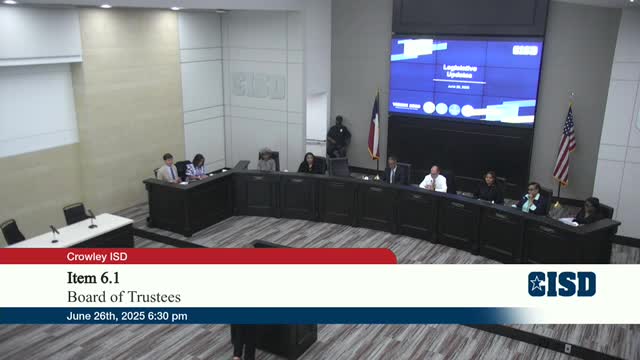
Summary
District staff summarized more than 100 education bills from the recent Texas legislative session and flagged several bills under district review, including proposals on religious displays, homestead tax exemptions, homeschooled student participation in UIL activities, and a ban on personal communication devices.
District staff briefed the Crowley ISD Board of Trustees on legislative activity from the Texas regular session and outlined several bills that the district is reviewing for policy changes and board action.
The presenter said more than 1,200 bills moved through the regular session, roughly 600 of which the governor had signed at the time of the briefing, and that about 106 of those bills concerned public education. Staff identified several 'hot topics' under administrative review that will move to the district's policy review committee and then to the full board: display of the Ten Commandments in public school classrooms and related prayer or religious-text provisions; proposals to increase the exemption amount of resident homesteads from ad valorem taxation by school districts (legislation cited as Senate Bill 4 and Senate Bill 23 in the briefing); Senate Bill 401 relating to participation of non-enrolled students in University Interscholastic League-sponsored activities; and House Bill 1481 relating to student use of personal communication devices.
Staff warned that many policy changes must be in place by Sept. 1 and that the coming weeks would be heavy with board decisions. The presenter also noted a special session beginning July 21 and that pending litigation has already been filed in Dallas County concerning classroom displays of the Ten Commandments.
On the specific issue of homeschooled students participating in district athletics under SB 401, staff said the athletic department and the district's legal counsel are reviewing possible implementations, and that UIL and TASB are discussing guidance. Trustee questions focused on funding and logistics; the presenter said students who are not included in the district's average-daily-attendance calculations would not generate state funding, meaning the district would bear the cost of participation unless funding rules change.
House Bill 1481 on personal communication devices prompted a planned district response: staff said they will gather stakeholder feedback via a parent survey and focus groups and use that input to craft expectations and enforcement protocols to avoid shifting enforcement burdens onto classroom teachers.
Why it matters: the bills flagged by administration could require the district to adopt or amend policies affecting curriculum, classroom practice, funding, athletics eligibility and student-device rules. Administration said those items will move to the policy review committee and would likely return to the board for action before the start of the school year.
What's next: staff said administration will continue to review specific bills, coordinate with TASB and UIL where relevant, convene stakeholder input sessions and bring draft policy changes to the policy review committee and the full board.