
North Dakota Supreme Court hears challenge to juvenile witness after sequestration breach
Get AI-powered insights, summaries, and transcripts
Subscribe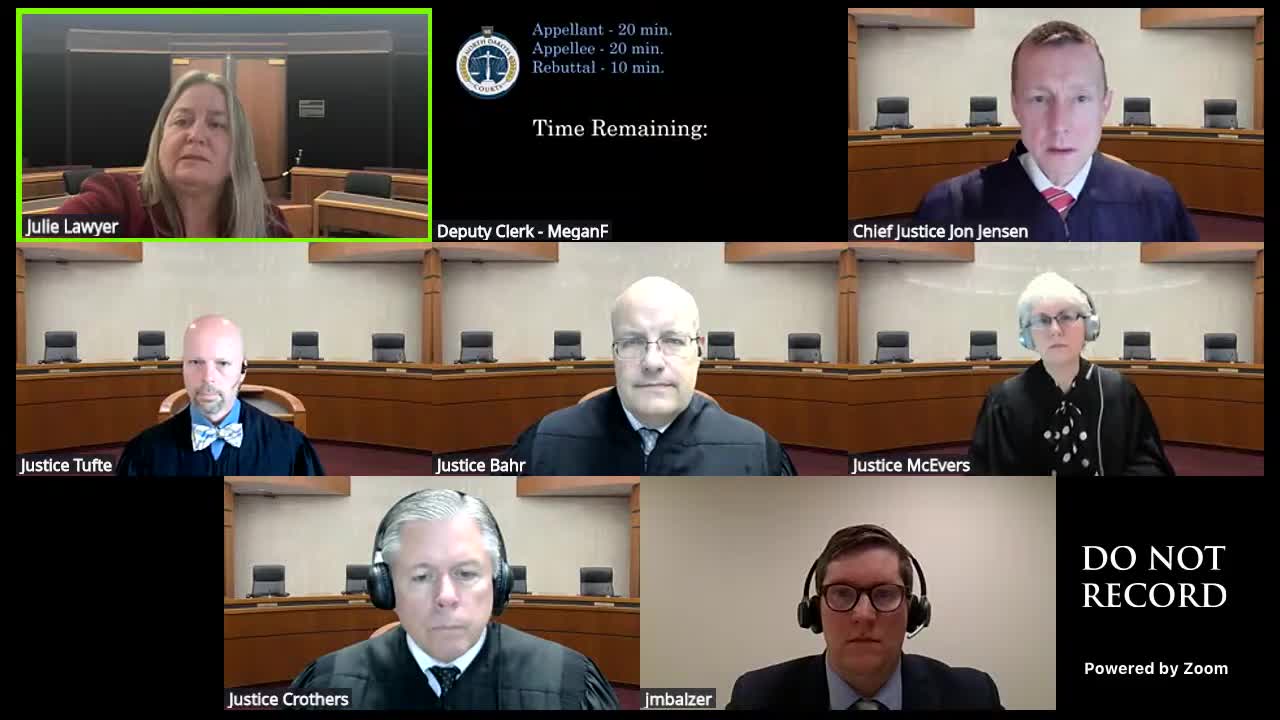
Summary
Attorneys argued before the North Dakota Supreme Court over whether a 15-year-old witness who watched local news coverage in violation of a sequestration order should have been allowed to testify at trial and whether that testimony was essential to the guilty verdict against Corbin Lampert.
BISMARCK — The North Dakota Supreme Court heard oral arguments over whether a juvenile witness’s intentional viewing of news coverage in violation of a court sequestration order should have barred him from testifying at trial, and whether that testimony was critical to upholding Corbin Lampert’s conviction.
Justin Balzer, a public defender with the Bismarck Public Defender’s Office, told the court the district judge erred by allowing the 15-year-old identified in the record as “VH” to testify after VH admitted he had “intentionally sought those videos out” and watched local news clips while a sequestration order was in effect. Balzer argued the deliberate violation itself shows the witness “would have been influenced by that prior testimony” and that the juvenile’s testimony was the state’s most important evidence because, Balzer said, VH was the only witness who placed Lampert close enough to the victim for the expert’s description of a close-contact wound to be possible.
Julie Loehr, representing Burley County for the state, told the justices the district court did not abuse its discretion in allowing VH to testify. Loehr said the judge had before her VH’s statement during a voir dire in which VH said he had not heard testimony from other juvenile witnesses about the subjects VH would address and that the jury was shown VH’s earlier recorded interview with law enforcement so jurors could compare the prior statement and his trial testimony.
The dispute centers on the court’s handling of a sequestration order granted before trial, with the exception of Detective Guttenberger, the case agent, who remained at counsel table. Prosecutors told the court during the trial that VH had viewed media coverage — identified in the record as local television clips — despite being instructed not to view media. VH confirmed outside the jury’s presence that he had watched the clips and that he “remembered certain parts of the testimony,” including hearing audio from another juvenile who had testified earlier.
Balzer said VH’s testimony at trial included a new assertion — that a second firearm was present and that a weapon had been found on another juvenile, not Lampert — that VH had not reported to law enforcement in his interview and that other juvenile witnesses did not testify to a second firearm. Balzer argued VH’s intentional search for media was “in and of itself” evidence that his testimony was influenced and distinguished that conduct from prior case law the parties discussed, which allowed rebuttal testimony when witnesses had remained in the courtroom rather than having deliberately sought outside information.
Loehr countered that VH’s trial testimony was largely consistent with his earlier statements to police, that the recorded interview was played for the jury (identified in the trial record as Exhibit 41), and that jurors received standard credibility instructions. She also argued that even without VH’s testimony there was sufficient evidence for conviction, citing a social-media-style “live photo” video introduced at trial (Exhibit 52) that prosecutors say shows Lampert holding a firearm at Pioneer Park on June 25, 2023, witness testimony that placed Lampert near the victim immediately before or after the shooting, and witness statements that Lampert later told a companion he thought he had killed someone that night.
Justices asked whether a deliberate violation of a sequestration order should automatically bar testimony as a matter of law or remain a discretionary determination by the trial court. Balzer urged a rule of exclusion where a witness intentionally seeks out prohibited information; Loehr emphasized the district court’s evaluation of whether the violation would actually “lead to the witness changing their testimony or tailoring it to what they had previously heard.”
No decision was announced from the bench. The case record before the justices includes the trial transcript, VH’s pretrial recorded interview, the exhibits referenced by counsel, and the district court’s voir dire and ruling allowing VH to testify. If the Supreme Court finds the district court erred and deems the error not harmless, the remedy could include a new trial; if it finds any error harmless beyond a reasonable doubt, the conviction could stand. The court reserved questions and invited further argument before taking the matter under advisement.