Get Full Government Meeting Transcripts, Videos, & Alerts Forever!
Get email alerts on the Budget topic
No spam. Unsubscribe anytime.
North Richland Hills staff previews FY2026 budget, flags economic uncertainty and timeline
Summary
City staff presented an overview of the FY2026 budget development process, described the city’s fund structure and debt approach, highlighted near-term dates for certified values and proposal delivery, and noted economic and legislative items that could affect revenues.
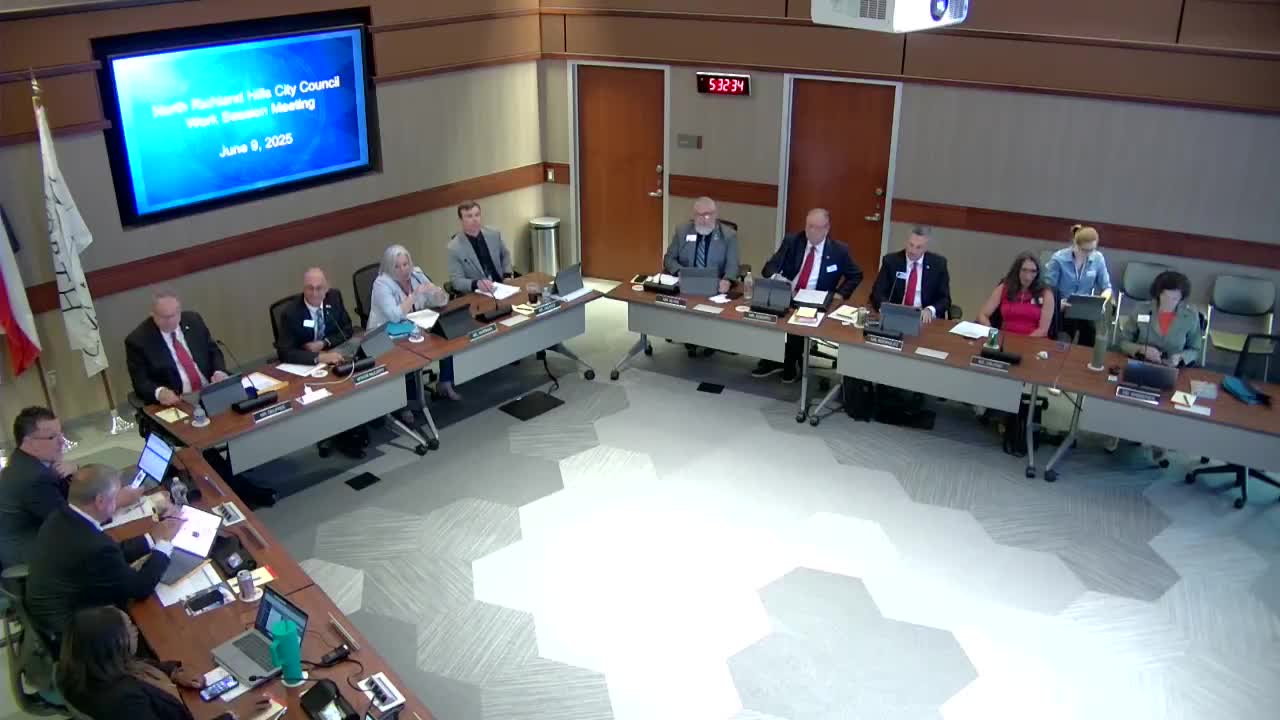
City staff presented an overview of the North Richland Hills proposed FY2026 budget at the City Council work session on June 9, 2025, outlining fund structure, revenue drivers and a development timeline ahead of a formal proposal this summer.
The presentation from finance staff framed next steps and timing: special revenue funds will be presented at the June 23 meeting; certified property-taxable values from the Tarrant Appraisal District (TAD) are expected on Friday, July 25; the city manager will present a proposed FY2026 budget to the council on Monday, July 28; and a full-day budget work session is scheduled for Friday, Aug. 1.
The nut graf: staff said the general fund remains the largest and most flexible fund, supported mainly by property tax, sales tax and franchise fees, and emphasized that revenue uncertainty — especially around property values and sales taxes — will drive budget decisions for next year.
Chase, a city staff presenter, summarized the city’s fund structure and recent changes. He said the city has 23 operating funds (including four internal service funds) and 16 capital funds organized into nine project categories. He explained the city’s two-part debt strategy: minimize property-tax-supported debt when possible and prioritize alternative funding sources so annual debt service can decrease over time and create future debt capacity.
On revenue drivers, staff noted that while North Richland Hills is larger than several comparison cities by population, the city’s general fund size places it “in the middle of the pack,” and the average residential tax bill for NRH is close to the bottom among peers. Staff also showed that roughly 55% of a typical property-tax dollar paid by an NRH resident goes to the school district, with the remainder split among county, special districts and the city.
Staff highlighted several numerical and legislative points that could affect FY2026 planning: the city’s parks fund receives a half-cent sales tax adopted by voters in 1992 (with about 31% of that fund’s revenue coming from the NRH Center), the Crime Control and Prevention District (CCD) fund derives most of its revenue from sales tax with about 10% coming from a cost-sharing agreement with BISD for school resource officers, and special revenue funds together account for about 3% of the city’s overall budget. Chase told council members that the 2025 adopted capital funds added to the city’s budget did not require issuing new debt.
Staff warned of uncertainty in property valuations. Chase said the most recent preliminary TAD estimate — from May — showed a 1.19% increase from last year’s certified taxable value, but he cautioned that the figure is preliminary, that inflation may outpace that change, and that certified values can still shift before TAD’s July certification. He also noted that ongoing appraisal challenges and post-certification adjustments could reduce certified values.
On legislative changes, staff briefed the council on bills of potential interest including measures affecting business personal property exemptions and a proposed increase in the homestead exemption for the school district from $100,000 to $140,000 if approved by voters. Chase said the business personal property exemption change goes to voters in November and that the school-district homestead proposal, if approved, would affect residents but not the city’s immediate FY2026 finances.
City Secretary Trudy clarified a new budget-notice requirement tied to recent legislation, saying, “Our city secretary receives a copy of the proposed budget 30 days before you all consider voting on it, and then we also make sure that the city secretary has a final copy in case anyone from the public requested.” Trudy added that a physical copy is made available at the city secretary’s office and the public library, with the full document posted online.
Council members asked questions about delinquencies, TAD procedures and the timing of bills if voters approve valuation-related measures. Staff said the city works with a delinquent-tax attorney to pursue late payments and that when taxpayers pay late they pay penalties and interest that the city receives in proportion.
The presentation closed with next-step dates for the council calendar and staff commitments to return with additional details: special revenue funds on June 23; certified values on July 25; proposed budget presentation on July 28; and a detailed budget work session on Aug. 1.
Looking ahead, staff said they will continue to monitor certified values, sales-tax performance and legislative changes as they develop the formal FY2026 budget proposal.